
About the Guide
The S.A.C.R.E.D. Intimacy Guide is a tool for reflection and critically thinking through sexual decision making. It is intended to enrich a couple’s sexual relationship, and to support individuals in confidently navigating their experience of sexuality.
Each component in the acronym is an integral contributor to the experience of holistic sexual wellbeing for Christian couples and individuals. It can be used as a decision-making tool, to critically think through sexual choices and behaviours, with an expansive and joyful view of sexuality in mind. The six dimensions of S.A.C.R.E.D. are interconnected. Some principles naturally overlap because sexual wellbeing cannot be separated neatly into individual parts.
The S.A.C.R.E.D. Intimacy Guide has been informed by multiple sexual health frameworks, while also being grounded in the Christian faith. Read more below.
How to Use the Guide
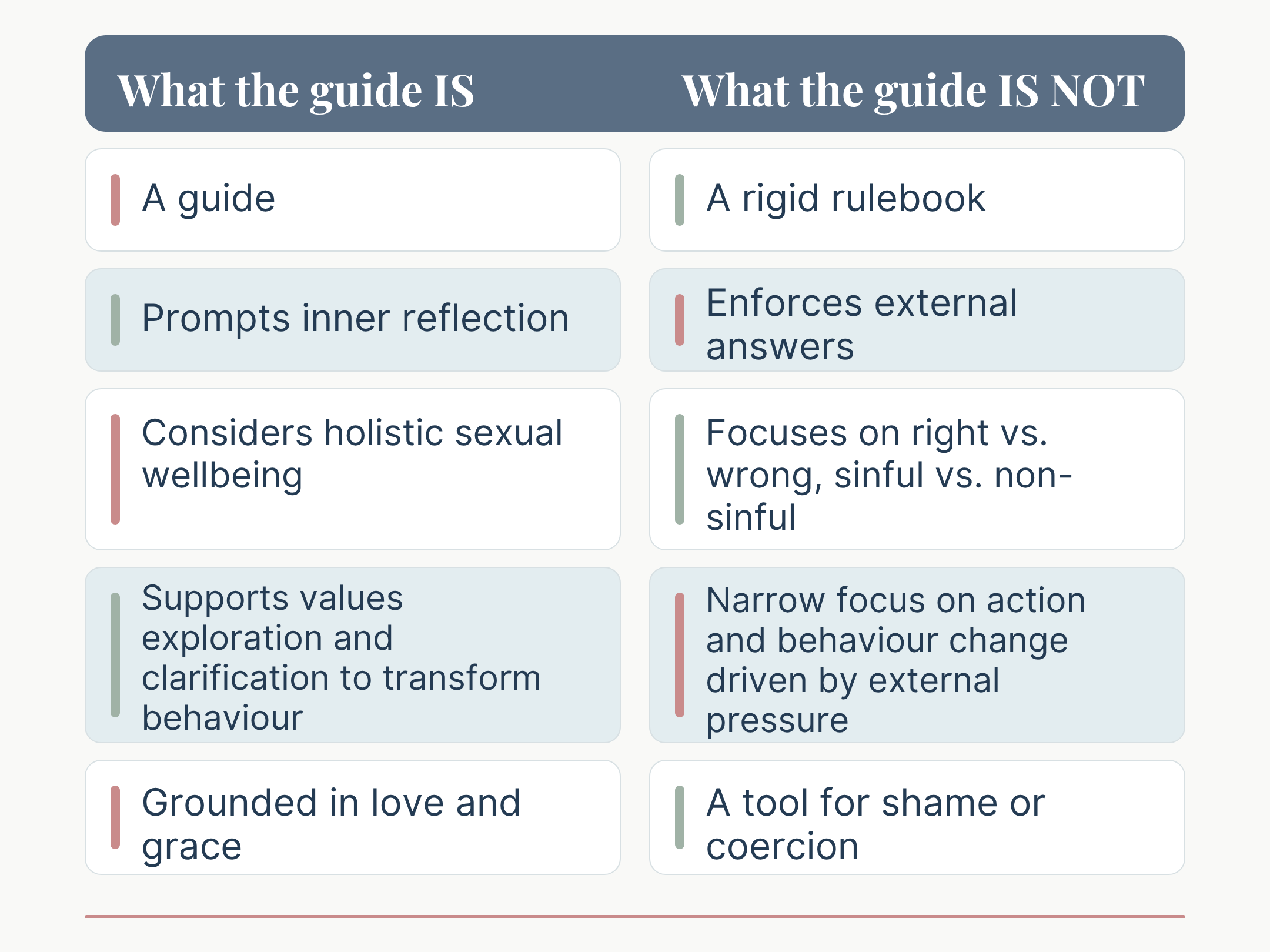
The S.A.C.R.E.D. Intimacy Guide can be used as a reflective tool, to think through our sexual choices and behaviours. Rather than asking is this right or wrong, sinful or not sinful, the S.A.C.R.E.D. Intimacy Guide aims to elevate our decision making towards choices that are values aligned, and that nurture holistic sexual wellbeing.
Whether you are exploring this framework as an individual or engaging in it alongside a partner as an "intimate team," here is how to use the S.A.C.R.E.D. Intimacy Guide in your daily life:
Approach with Curiosity, Not Judgment:
Pause before or after a decision to reflect with an open, non-defensive mind.
Replace self-criticism with gentle self-awareness: "What am I feeling right now? What desires, fears, or values are driving this choice?".
Practice Collaborative Dialogue:
Invite trusted people into your decision making: a friend, mentor, family member, pastor, or counsellor, or sexual health professional
Share your honest thoughts and feelings across these six pillars
In a relationship, shared-decision making is important to support the strengthening of a sexual team.
Responsibility for the Journey:
We are all inconsistent and contradictory at times. Where there may be inconsistencies or contradictions between your values and choices, can you fully own that? Accept it, make space for it, rather than deny or make excuses for those contradictions.
Honesty in our imperfections and inconsistencies invites responsibility and the possibility for meaningful, values-aligned change
Use the Six Pillars as Diagnostic Check-Ins:
Work through the S.A.C.R.E.D. acronym not as a rigid test, but as a set of aspirational coordinates.
Treat the reflection prompts as open-ended starting points.
Feel fully empowered to write your own questions that reflect your specific life stage, relationship context, or personal values.
Embrace the Lifelong Journey:
Recognise that sexual wellbeing is not a static state achieved overnight, but an evolving developmental process throughout your life.
When encounters do not go perfectly or when you face complexity, use the framework as a learning opportunity to extend grace to yourself and your partner, adjust expectations, and move forward in peace.
Embrace Being Human
Reject perfectionism. As humans we are often contradictory in nature and may not always align perfectly with these elements. Choose grace over shame.
Accept uncertainty. There may be many times where you do not know the answer, despite your best efforts to grapple with your decisions or choices. In these times, can you invite the knowledge: “I am not sure…AND I know I am loved”
The S.A.C.R.E.D. Intimacy Guide
A Christian Framework for Holistic Sexual Wellbeing
Elevating sexual decision making. Reflect, wrestle, choose with grace.
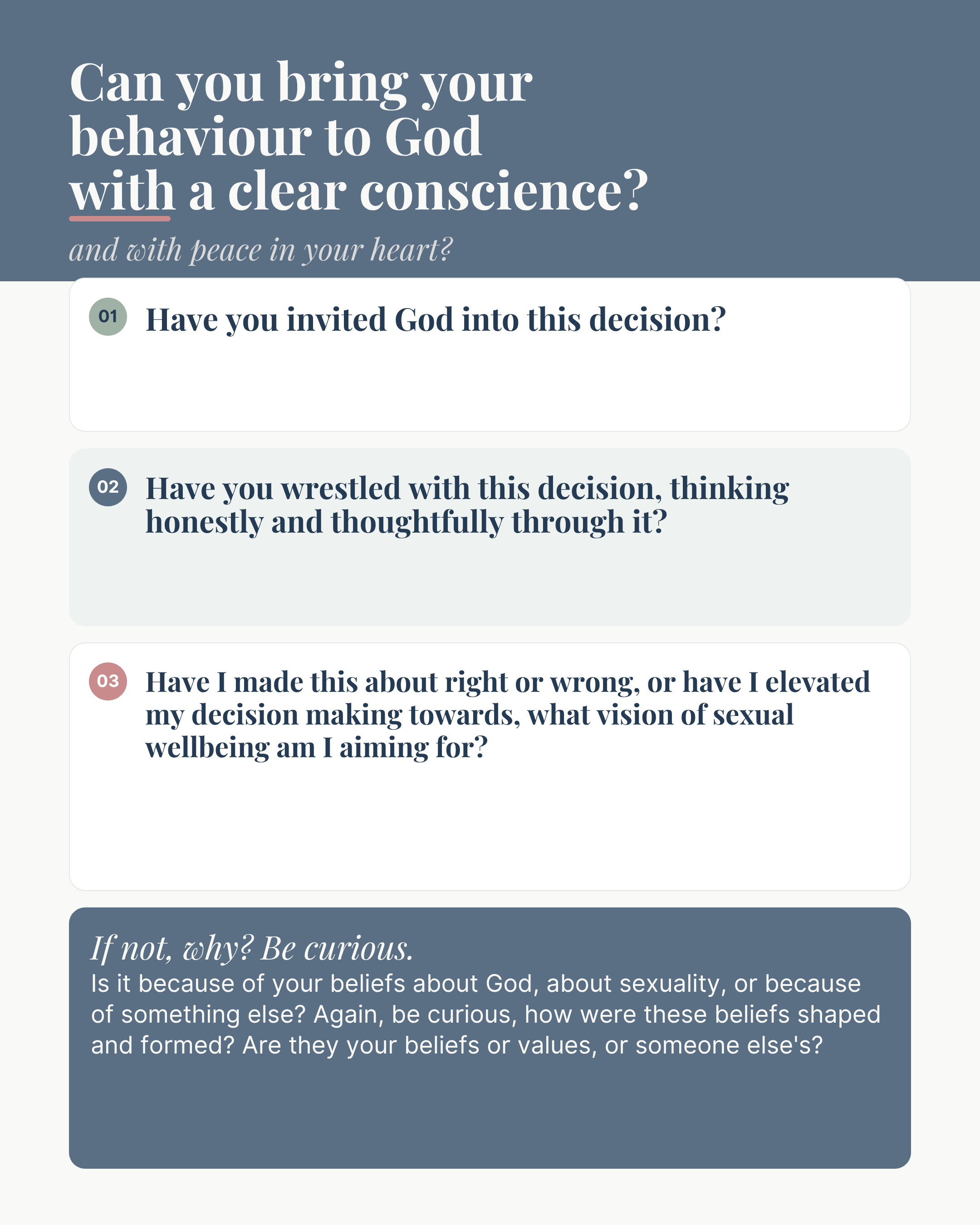
A Final Reflection

A Summary of Contributing Frameworks
Below is a summary of the key sexual wellbeing frameworks that have contributed to SACRED Intimacy and the S.A.C.R.E.D. Intimacy Guide. Click into each to expand and learn more.
-
The World Health Organization defines sexuality as:
“ …a central aspect of being human throughout life (that) encompasses sex, gender identities and roles, sexual orientation, eroticism, pleasure, intimacy and reproduction. Sexuality is experienced and expressed in thoughts, fantasies, desires, beliefs, attitudes, values, behaviours, practices, roles and relationships. While sexuality can include all of these dimensions, not all of them are always experienced or expressed. Sexuality is influenced by the interaction of biological, psychological, social, economic, political, cultural, legal, historical, religious and spiritual factors.” (1)What is important to highlight in this definition is that sexuality is expansive, and a part of the experience of every individual regardless of whether they are single, in a sexual relationship, or acting with or without sexual behaviour. The experience and expression of sexuality is holistic in that it is underpinned by biological, psychological, relational, societal, cultural, and spiritual factors. (1) This is understood as a biopsychosocial-spiritual approach to sexuality. (2) This biopsychosocial-spiritual, comprehensive, expansive understanding of sexuality is why the term “Holistic” Sexual Wellbeing is used in the SACRED Intimacy guide.
-
Recognising the expansive definition of sexuality, four pillars support the biopsychosocial experience of healthy sexuality. These pillars are distinct, but also interconnected. (3)
1. Sexual Health: This pillar focuses on the biological elements and physical functioning of sexuality including fertility, preventing and managing sexually transmitted infections, and sexual function such as desire and arousal. (3)
2. Sexual Pleasure: This pillar focuses on the physical and psychological pleasure derived from sexuality. This includes event related factors such as types of sexual activity, timing, and orgasm. It also includes people-related factors such as the sexual relationship, communication, trust, and mutual negotiation.
For sexual pleasure to occur it requires safety, consent, bodily integrity, and freedom of expression. (3)3. Sexual Justice: This pillar focuses on the social, cultural, and legal supports for a healthy experience of sexuality. (3)
For example this could look like social or legal efforts to address accessible holistic sexual education, or churches intentionally talking more openly about sexual relationships.4. Sexual Wellbeing: This pillar focuses on the relationship with one’s own sexuality and/or the sexual relationship with another through sexual safety and security, sexual respect, sexual self-esteem, resilience, forgiveness, self-determination, and comfort with sexuality. (3)
While in this framework Sexual Wellbeing is a distinct pillar, SACRED Intimacy uses the term “Sexual Wellbeing” to capture all four pillars. Sexual health and sexual wellbeing, and related concepts are terms that are often used interchangeably.
-
The Harvey Institute explores sexual health through 6 principles. As explored above, this is another example of how these key terms are often used interchangeably, due to the interconnected nature of sexuality.
The 6 Principles:
1. Consent: this is voluntary cooperation and the mutual permission to engage in sexual activity. Consent provides the space for sexual safety, genuine desire, pleasure, and transformation. Without consent, sex is an intrusion or violation. (4)
2. Non-Exploitation: This is a commitment to the protective boundary of not exploiting power within a relationship. Exploitation undermines full consent within a relationship by abusing power to secure sexual advantages. (4) An example of this is using the Bible against a partner, to pressure them into engaging in sex. (5) In committed relationship, infidelity is another example of exploitation through cover-up, denial, and manipulation of trust. (4)
3. Honesty: This is founded on open and direct communication with yourself and with your partner. It involves an openness and awareness of your own experience of sexuality. It involves effective, transparent communication about sexuality and the sexual relationship with a partner. Honesty is required for relationships to uphold the other principles of sexual health. For example, without full honesty, full consent cannot be given. (4)
4. Shared Values: Our values inform our sexual standards and motivations for our expressions of sexuality. Within relationships, it is essential that partners can honestly share their values, including their differing values to support intimacy over secrecy and deception. Partners can determine their shared values and build on this foundation. (4)
5. Prevention: Proactive responsibility for individual and partnered sexual health including taking active steps to understand and utilise contraceptive methods to avoid unwanted pregnancy, safer sex practices to reduce the transmission of Sexually Transmitted Infections (STIs), and knowledge of personal and family medical history. (4)
6. Pleasure: This principle recognises that a primary motivation for sexual activity is pleasure. Within sexual health, it is essential to balance sexual safety and sexual responsibility with exploring sexual interests and sexual pleasure. (4)
-
SACRED Intimacy is committed to providing comprehensive sex education (CSE), tailored to an adult Christian audience. CSE is shown to be highly effective in delaying sexual debut, reducing risk-taking, decreasing sexual partners, and increasing safer sex practices. (6, 7) On the other-hand, abstinence-only and purity culture messaging prolific in Evangelical contexts shows little to no delay in sexual initiation, no decrease in the number of sexual partners, increasing risk for STIs and unintended pregnancy, is ineffective in its aims in that a vast majority of individuals engage in premarital sex, and can even promote sexual abuse. (7-9)
In a Christian faith context, SACRED Intimacy draws upon a relationship-based sexual value system. (10) Within this system, sexuality is seen as a God-given capacity, where sexuality and sexual pleasure is a positive gift. This system focuses on the holistic quality of the relationship by including mutuality, safety, and active consent. The sacred text of the bible is held, at the same time acknowledging contemporary science and research. This framework is about the empowerment to discern, moving beyond just saying “no”, to learning how to say a responsible “yes”. (10)
-
While the SACRED Intimacy vision of holistic sexuality is aspirational, it is also grounded in reality. A harm reduction approach is compassionate, pragmatic, and realistic. (11) Moving away from education focused solely on rigid safe vs. unsafe, disease-prevention, or abstinence only messaging, a harm reduction approach recognises the complexity of human sexual behaviour. (11)
The core principles include:
1. Meeting people where they’re at: sexual harm reduction recognises the reality of human sexual behaviour and focuses on minimising negative consequences, rather than demanding perfection.
2. Respecting individual agency: people are self-determining decision-makers, calculating and accepting risk due to the personal or relational meaning the decision holds.
3. Valuing incremental changes: a positive behavioural success no matter how small is worth celebrating. Any step to make a sexual activity, even a extremely risky one, slightly safer is a positive step.
4. Compassion and pragmatism over stigma: when behaviour is labelled as “deviant” or “bad: this only leads to further harm due to hiding behaviour, alienation, and avoidance of seeking support out of shame. Harm reduction creates the space for honest, rational conversations about risk.
5. The pleasure-safety continuum: harm-reduction recognises that many pleasureable sexual behaviours carry some risk. Rather than the fear that talking about these behaviours will encourage them, harm-reduction seeks to provide the information that allow people to navigate these desires and make an informed decision.
The pleasure-safety continuum recognises two polar ends: unbound/restricted pleasure, and restricted sexual safety.
a. Unbound/restricted pleasure: Individuals do not recognise of honour limits, prioritising pleasure and desire
b. Restricted sexual safety: Absolute risk-avoidance and safety is the sole priority.
A harm reduction approach allows for the navigation of both pleasure and safety, rather than forcing a choice between two extremes. It supports people to explore the balance of their boundaries, bodies, and desires. (11)A harm-reduction approach informs SACRED Intimacy by shifting the conversation from “this is right, that is wrong”, to providing a comprehensive framework for decision making and a commitment to providing evidence-based information to support informed choices, and promote safer sex behaviour regardless of the individual decision made.
-
Founded by a sexual health practitioner in Australia, Sacred Intimacy is committed to upholding the ethics of the Society of Australian Sexologists Code of Ethics and Practice. These ethical tenets are reflected in and promoted by the SACRED Intimacy Faith-Informed Guide:
1. Integrity through acting in good faith.
2. Respect for people, their experiences and autonomy.
3. Justice through respecting human rights and dignity.
4. Beneficence through a commitment to promote wellbeing.
5. Non-Maleficence through a commitment to avoiding harm.
6. Autonomy through promoting and enhancing self-determination.
-
World Health Organization. Sexual health [Internet]. Geneva: World Health Organization; [cited 2026 Jul 22]. Available from: WHO Sexual Health
McCarthy B, Ross LW, Metz M. The good enough sex model. In: Kleinplatz PJ, editor. New directions in sex therapy: innovations and alternatives.
Mitchell KR, Lewis R, O'Sullivan LF, Fortenberry JD. What is sexual wellbeing and why does it matter for public health? Lancet Public Health. 2021;6(8):e608-e613. doi:10.1016/S2468-2667(21)00099-2.
The Harvey Institute. Six principles of sexual health [Internet]. [cited 2026 Jul 22]. Available from: The Harvey Institute — Six Principles of Sexual Health
Sawatsky J, Lindenbach R, Gregoire SW, Gregoire K. Sanctified sexism: effects of purity culture tropes on White Christian women's marital and sexual satisfaction and experience of sexual pain. Sociol Relig. 2025;86(4):519-543. doi:10.1093/socrel/srae031.
Vanwesenbeeck I. Comprehensive sexuality education. In: Oxford Research Encyclopedia of Global Public Health [Internet]. Oxford: Oxford University Press; [cited 2026 Jul 22]. Available from: Oxford Research Encyclopedia entry
Ponzetti JJ Jr, editor. Evidence-based approaches to sexuality education: a global perspective. Milton: Taylor & Francis Group; 2015.
Estrada LL. Clinical considerations of the evangelical purity movement's impact on female sexuality. J Sex Marital Ther. 2022;48(2):121-132. doi:10.1080/0092623X.2021.1977445.
Owens BC, Hall MEL, Anderson TL. The relationship between purity culture and rape myth acceptance. J Psychol Theol. 2021;49(4):405-418. doi:10.1177/0091647120974992.
Moles K. Religion and sexuality education. In: Ponzetti JJ Jr, editor. Evidence-based approaches to sexuality education: a global perspective. Milton: Taylor & Francis Group; 2015. p. 209-222.
Naisteter MA, Sitron JA. Minimizing harm and maximizing pleasure: considering the harm reduction paradigm for sexuality education. Am J Sex Educ. 2010;5(2):101-115.