D - Dignity

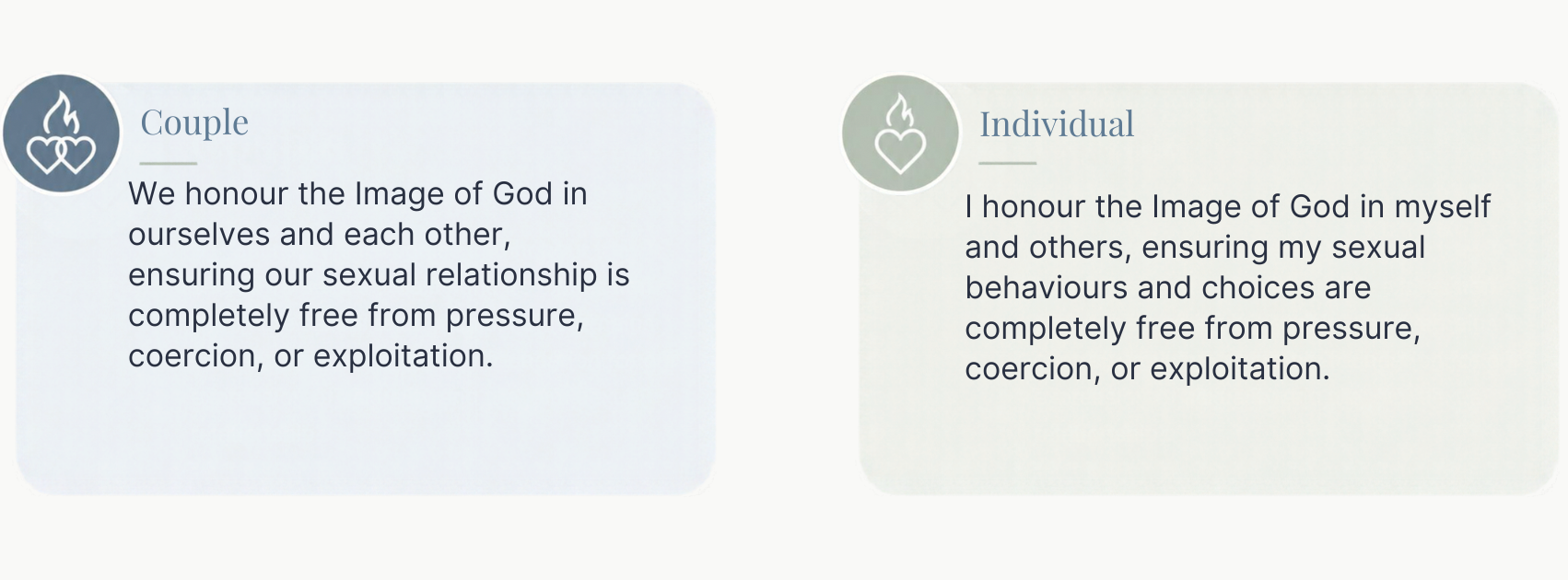
We honour the Image of God in ourselves and each other, choosing responsibility and standing against exploitation.

Comparison of vows: on the left, a couple vows to honor God's image and each other in their sexual relationship, free from pressure, coercion, or exploitation; on the right, an individual vows to honor God's image in themselves and others, ensuring their own and others' sexual behaviors are free from pressure, coercion, or exploitation.

The Image of God (Imago Dei): Respecting Inherent Worth

Every person carries inherent, God-given worth through being created in the Image of God.

Read more

At the centre of human dignity is the conviction that human beings are created in the Image of God. It is this Image of God that gives incredible, divinely granted worth. This worth is deserving of respect, and the sexual relationship honours this worth by treating each person with care. A respecting relationship is never pressuring, demeaning, harassing, or belittling of a partner. (1, 2)

Likewise, we have a relationship with our own self, and it is important that we also honour the Image of God within ourselves by treating ourselves with kindess, compassion, and behaving in self-loving ways. (3)

Seeing the Whole Human

Sexual intimacy involves whole human beings; body, mind and soul.

Read more

This principle is about recognising the self and the other as a whole human being with a whole body, mind, and soul. When we engage in a sexual relationship, we engage both as a whole human being and relating to and with the other whole human being. (1)

We do not reduce ourselves or the other to just a part, for example just a body part. While during sexual activity there may be focus in the moment on a specific body part or physical act, it is within the context of relating to the other (and/or self) as a whole human being.

When seeing a whole human, this invites the sharing of the sexual experience, the sharing of sexual pleasure, rather than using another person or even your own body as merely an object. (3) Seeing the whole human welcomes relationship over transaction.

Self-Responsibility and Freedom of Choice

Each person has responsibility and freedom over their own body, mind, sexuality and choices.

Read more

Each individual has the full power and responsibility for how they choose to exercise and express their sexuality. An individual’s sexuality is their responsibility, not the responsibility of a partner to manage for them. (1, 4-6)

As an individual with this right and responsibility, it is important to exercise this wisely, while also respecting your partner’s same right and responsibility. While sexuality is a personal responsibility, the shared experience of the sexual relationship is the responsibility of both partners to support and nurture, with the full freedom of a genuine no and yes. (1, 4-6)

Non-Exploitation

Dignity requires a commitment not to use power, pressure, manipulation or coercion for sexual advantage or gratification.

Read more

This is a commitment to the protective boundary of not exploiting power within a relationship. Exploitation undermines full and active consent within a relationship by abusing power to secure sexual advantages. An example of this is using the Bible against a partner, to pressure them into engaging in sex. (4-7)

In committed relationship, infidelity is another example of exploitation through cover-up, denial, and manipulation of trust. Non-exploitation also includes the commitment to not engage in sexual behaviour that objectifies, demeans, or dehumanises another for individual gratification, selfish reasons or otherwise. (4-7)

Principles of Dignity

As it is the case with sexuality and all of its possible components, depending on whether a person is single or in a relationship, choosing to be sexually active or not, influences the degree to which these principles are expressed or not.
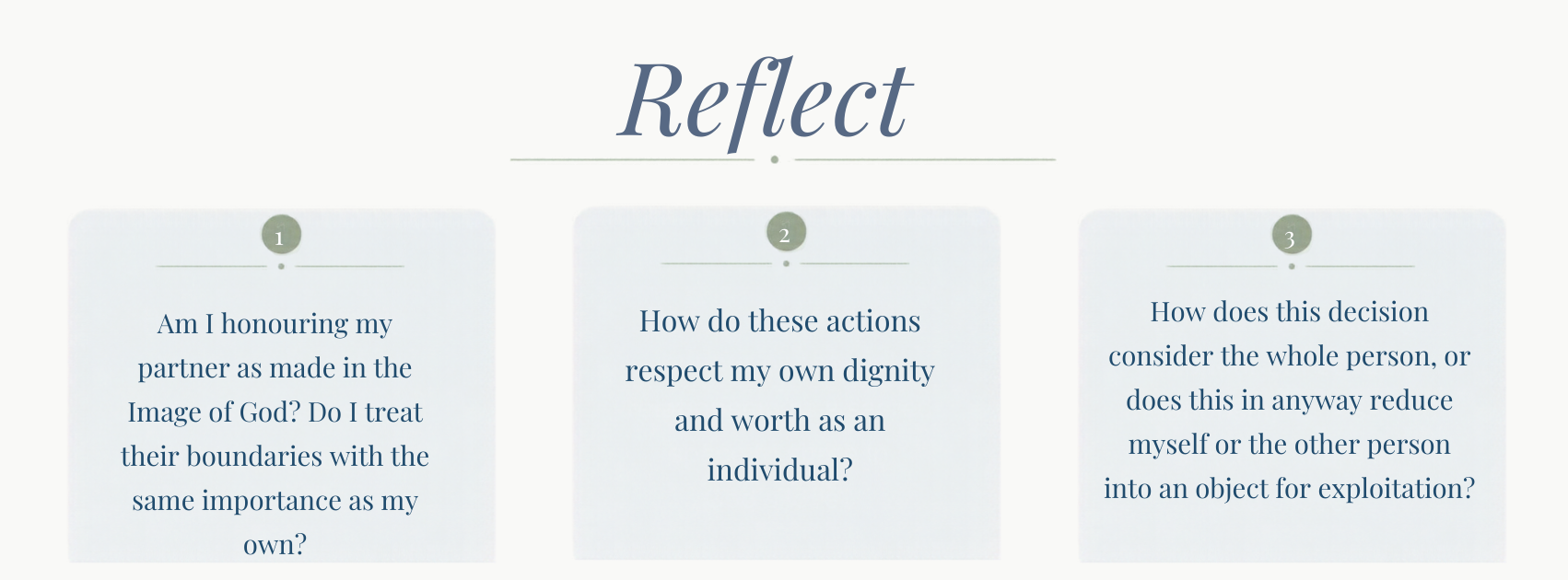
Three sections of reflective questions on a light-colored background with the title 'Reflect' at the top. Each section contains a question about respecting others and oneself in relationships.
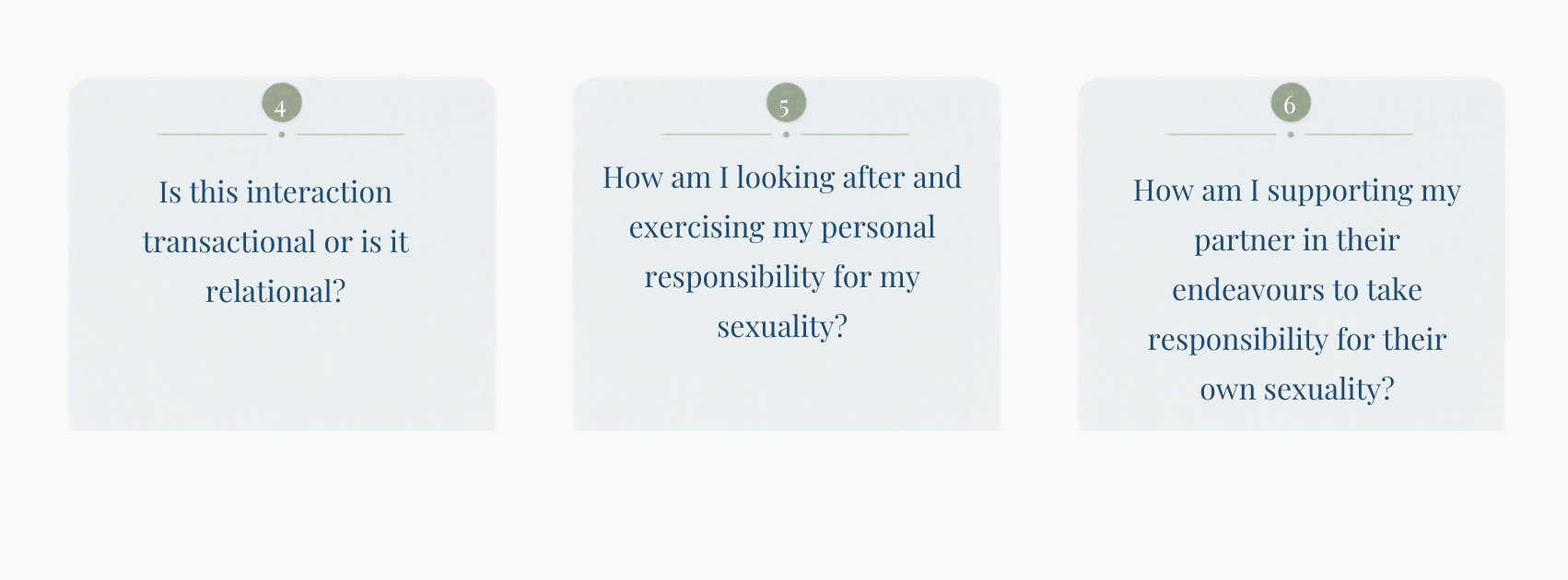
Three cards with questions about personal responsibility and sexuality, numbered 4, 5, and 6.

What other questions might you ask?

Curious about our sources?

View
  1. Thomas G. Sacred marriage: what if God designed marriage to make us holy more than to make us happy? Grand Rapids (MI): Zondervan; 2015.
  2. Sellers TS. Sex, God, and the conservative church: erasing shame from sexual intimacy. New York (NY): Routledge; 2017.
  3. Gregoire SW, Lindenbach RG, Sawatsky J. The great sex rescue: the lies you've been taught and how to recover what God intended. Grand Rapids (MI): Baker Books; 2021.
  4. The Harvey Institute. Six principles of sexual health [Internet]. [cited 2026 Sep 21]. Available from: https://www.theharveyinstitute.com/six-principles-of-sexual-health
  5. Mitchell KR, Lewis R, O'Sullivan LF, Fortenberry JD. What is sexual wellbeing and why does it matter for public health? Lancet Public Health. 2021;6(8):e608-e613.
  6. Martin B, Mayes R. The art of receiving and giving: the wheel of consent. Seattle (WA): Luminare Press; 2021.
  7. Moles K. Religion and sexuality education. In: Schroeder E, Kuriansky J, editors. Sexuality Education: Past, Present and Future. Vol. 1. Westport (CT): Praeger; 2009. p. 185–197.

A Gentle Reminder