C - Care for Holistic Health

We steward the body, mind, spirit, and relationships towards sexual wellbeing, and are committed to preventing harm.
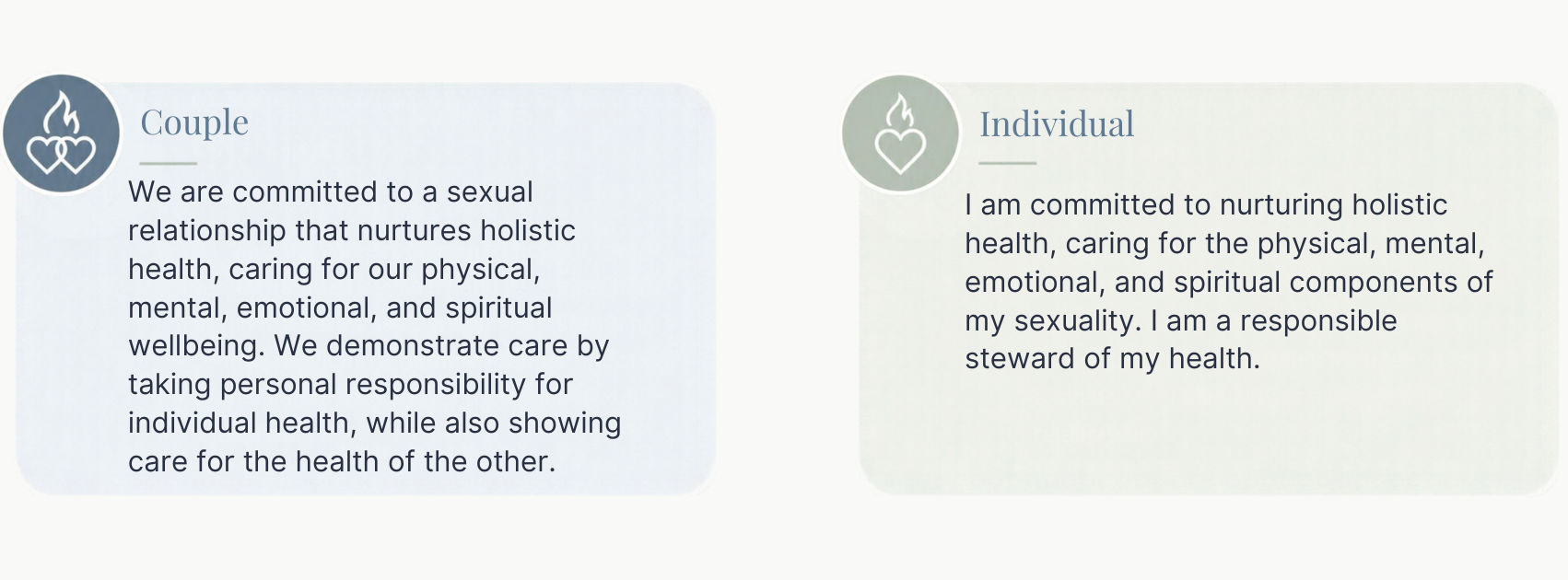
Two cards with text about holistic health. The left card is for couples, featuring a heart and flame icon, and the right card is for individuals, with the same icon. Both cards contain statements about commitment to health and wellbeing.

Principles of Care for Holistic Health

Biopsychosocial-Spiritual Sexuality

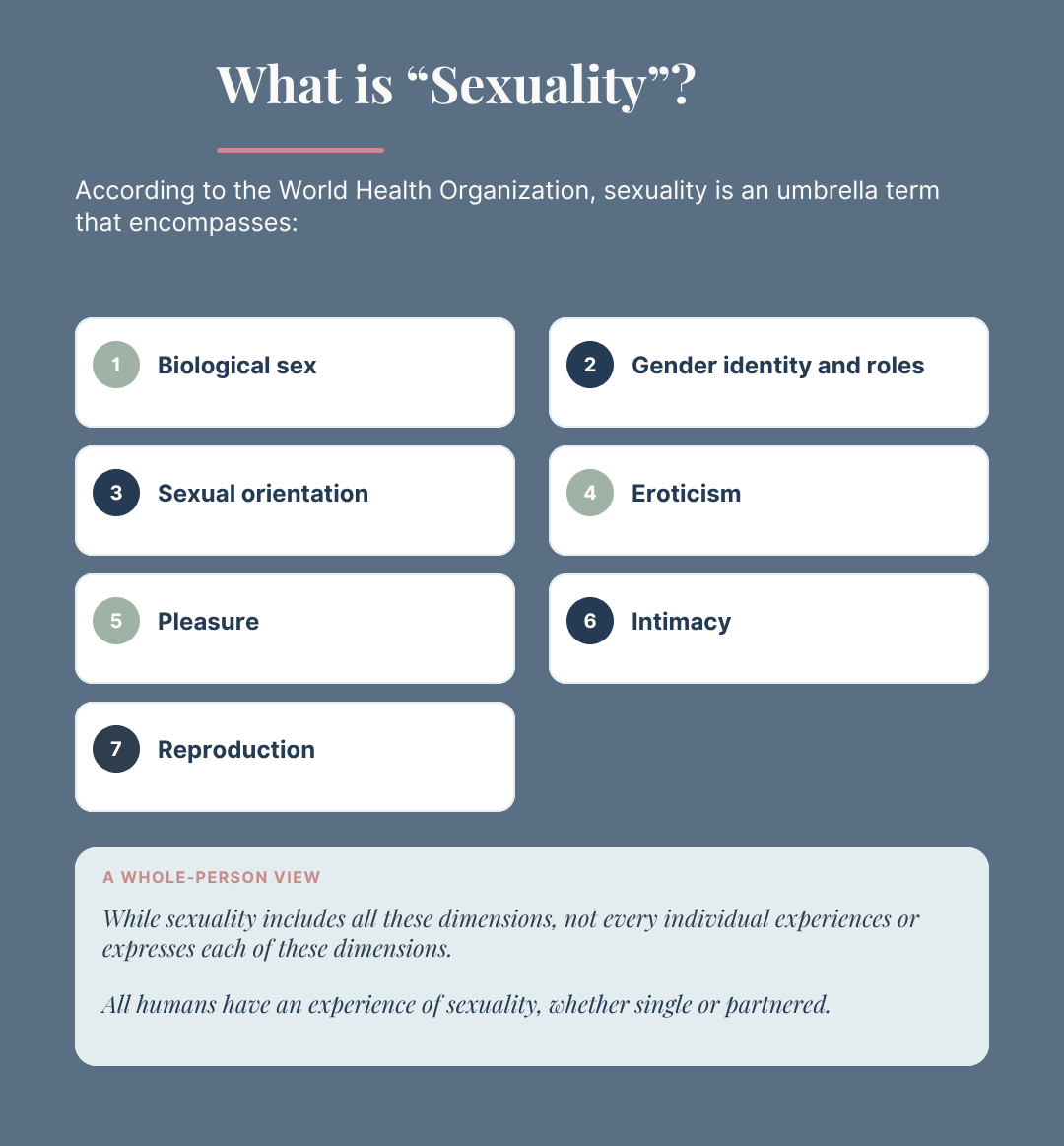
Our sexuality is holistic, shaped by the interconnected physical, psychological, relational, societal and spiritual dimensions of our lives.

Read more

Care for Holistic Health recognises the experience and expression of sexuality is holistic; it is underpinned by biological, psychological, relational, societal, cultural, and spiritual factors. (1) This is understood as a biopsychosocial-spiritual approach to sexuality. (2) This biopsychosocial-spiritual, comprehensive, expansive understanding of sexuality is why the term “Holistic” Sexual Wellbeing is used in the SACRED Intimacy guide.

Physical health includes elements such as caring for our physical bodies, understanding our anatomy, and being responsible for our sexual functioning and sexual behaviour. (1-3)

Psychological health recognises the deeply intertwined emotional and mental components of our sexuality. To improve our sexual wellbeing, it is essential to understand our emotions, thoughts, beliefs, and values when it comes to our sexuality. Care for our psychological health includes expressing our sexuality in ways that support our overall psychological wellbeing, free from sexual shame. (3,4)

Relational health recognises the broader context of our relationships, and how the expression of our sexuality is both influenced by our relationship, and can enhance our overall relationship. (2, 5, 6)

Societal health recognises that we are both influenced by and actively influence our broader communities. How we choose to express our sexuality is not an entirely private experience. Our sexual attitudes and values can be shaped by broader society, and likewise we can perpetuate those messages through active agreement, passivity, or we can consciously contribute towards healthy sexual messaging. (3, 6, 7)

Spiritual health recognises that as a Christian, expressing our sexuality has a sacred reality, and the ways in which we choose to express our sexuality can nourish us spiritually. (5, 6)

Nurturing Wellbeing

Caring for our holistic health means nurturing expressions of sexuality that support our physical, psychological, relational and spiritual wellbeing.

Read more

Wellbeing is a positive experience of health and wholeness. (1) Rather than measuring health by the absence of disease, dysfunction and risk-avoidance behaviour, the goal is about thriving. (3) When we care for our holistic health, we are aiming for an expression of our sexuality that nurtures us physically, psychologically, relationally, and spiritually.

Prevention and Management

Caring for our holistic health includes taking active responsibility for preventing and managing potential sexual health concerns.

Read more

Prevention and management is about taking active responsibility for our bodies. While wellbeing is aspirational, it is also important to recognise the reality of physical health issues such as infertility, unplanned pregnancy, and sexually transmitted infection. (4) To be responsible stewards, safer sex practices are applied such as clear contraceptive plans, barrier methods, and medical support. (4) In a sexual relationship, responsibility is shared with mutual care, rather than placed solely on one person. (4)

Harm Reduction

Harm reduction recognises the realities and complexities of human sexual behaviour and seeks to reduce potential risks and harms through accurate information and practical strategies.

Read more

While the SACRED Intimacy vision of holistic sexuality is aspirational, it is also grounded in reality. Harm reduction recognises the risk or harm that may be present in chosen sexual behaviours and then takes active steps to reduce risk and minimise that harm. (8)

Rather than shying away from providing information, a harm reduction approach recognises the reality that humans engage in risky sexual behaviour, and providing information supports informed decision making and healthier choices. Moving away from education focused solely on rigid safe vs. unsafe, disease-prevention, or abstinence only messaging, a harm reduction approach recognises the complexity of human sexual behaviour. A harm reduction approach is compassionate, pragmatic, and realistic. (8)

As it is the case with sexuality and all of its possible components, depending on whether a person is single or in a relationship, choosing to be sexually active or not, influences the degree to which these principles are expressed or not.
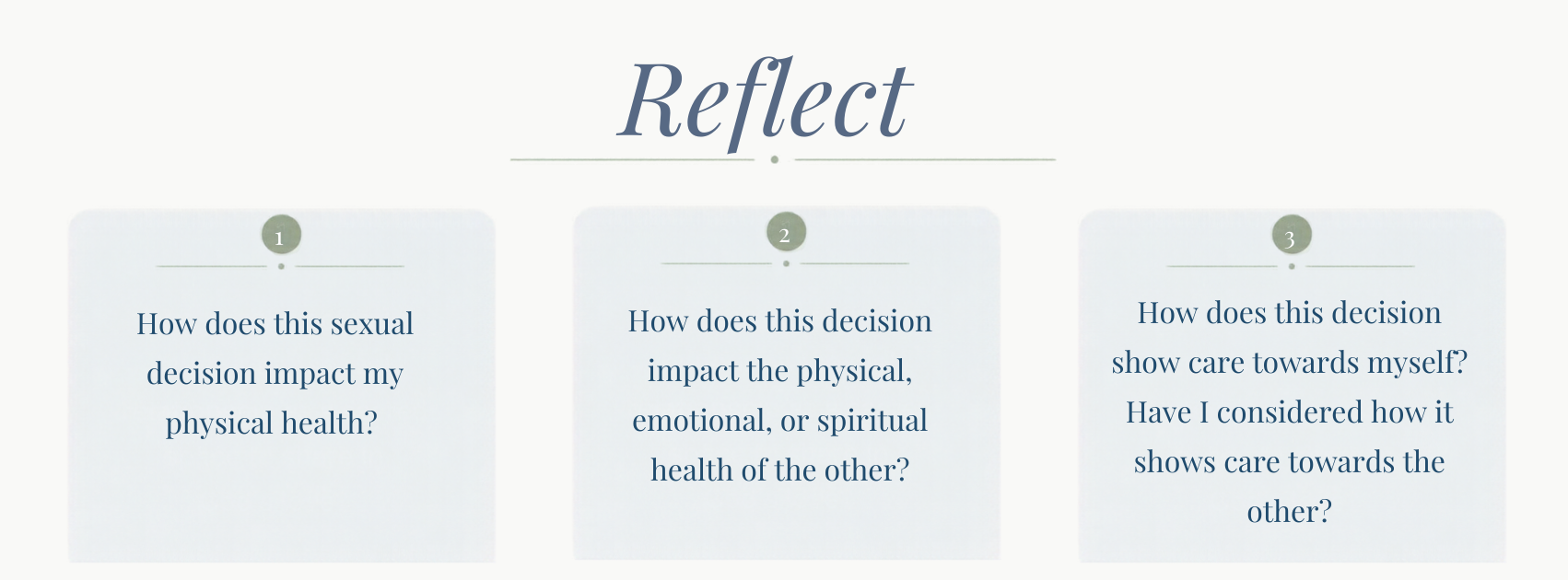
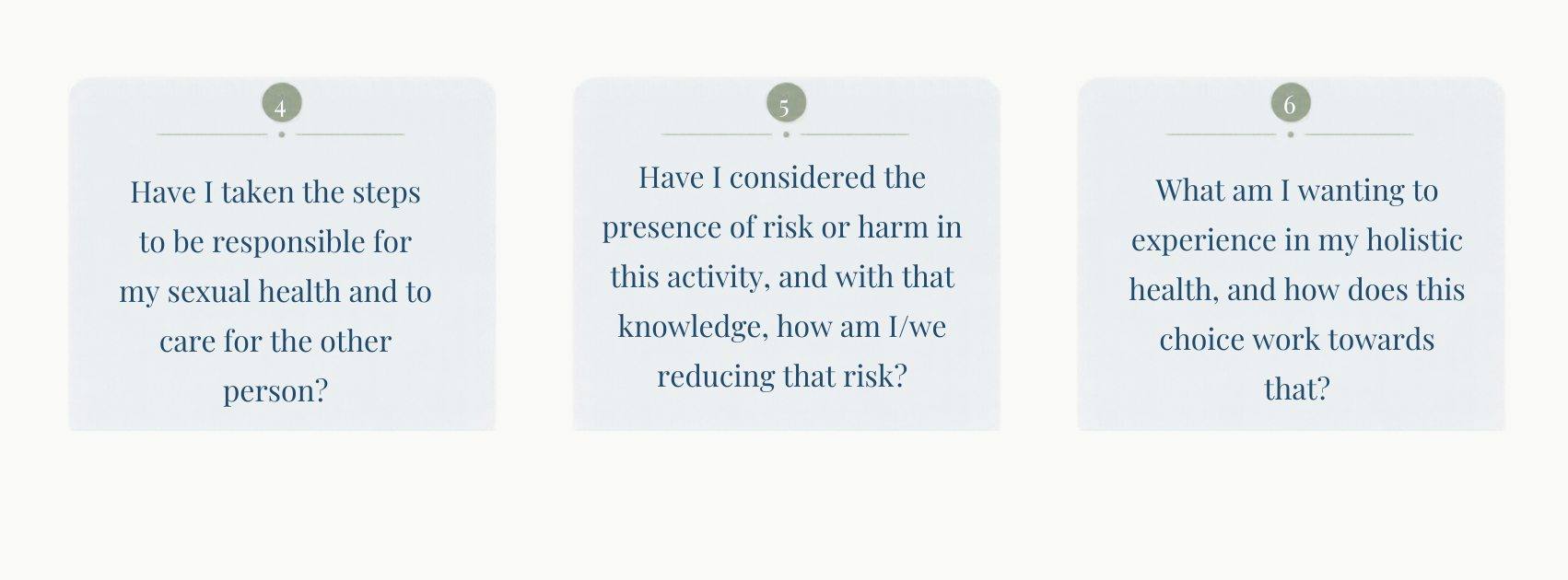
Three columns titled "Reflect" with questions about decision impacts on health, emotional and spiritual well-being, with light background and elegant font
Three light blue cards with numbered headings 4, 5, 6, containing questions about responsibility, risk, and health choices in sexual health.

What other questions might you ask?

Curious about our sources?

View
  1. World Health Organization. Sexual health [Internet]. Geneva: World Health Organization; 2026 [cited 2026 Sep 21]. Available from: https://www.who.int/health-topics/sexual-health
  2. McCarthy B, Ross LW, Metz M. The good enough sex model. In: Kleinplatz PJ, editor. New directions in sex therapy: innovations and alternatives. 3rd ed. New York (NY): Routledge; 2024.
  3. Mitchell KR, Lewis R, O'Sullivan LF, Fortenberry JD. What is sexual wellbeing and why does it matter for public health? Lancet Public Health. 2021;6(8):e608-e613.
  4. The Harvey Institute. Six principles of sexual health [Internet]. [cited 2026 Sep 21]. Available from: https://www.theharveyinstitute.com/six-principles-of-sexual-health
  5. Kleinplatz PJ, Ménard AD, Paquet MP, Paradis N, Campbell M, Zuccarino D, Mehak L. The components of optimal sexuality: A portrait of “great sex”. Can J Hum Sex. 2009;18(1–2):1–13.
  6. Moles K. Religion and sexuality education. In: Schroeder E, Kuriansky J, editors. Sexuality Education: Past, Present and Future. Vol. 1. Westport (CT): Praeger; 2009. p. 185–197.
  7. United Nations Educational, Scientific and Cultural Organization (UNESCO). International technical guidance on sexuality education: An evidence-informed approach. Revised ed. Paris: UNESCO; 2018.
  8. Naisteter MA, Sitron JA. Minimizing harm and maximizing pleasure: considering the harm reduction paradigm for sexuality education. Am J Sex Educ. 2010;5(2):101-115.

A Gentle Reminder