A - Authentic Agreement

We cultivate the freedom and safety to engage in sexual expression with genuine choice, without pressure or coercion.
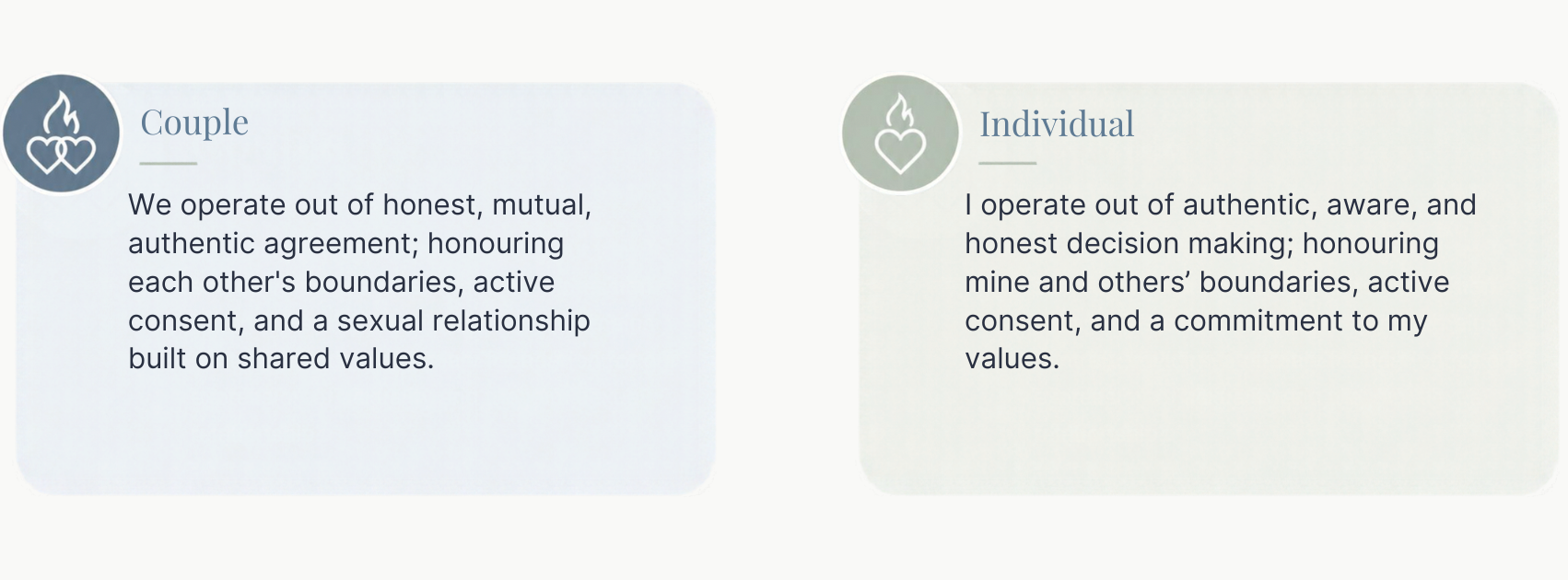
Comparison of relationship values: one side features a couple emphasizing mutual agreement and boundaries; the other side features an individual emphasizing authentic, honest decision-making and personal values.

Active Consent

Sexual intimacy requires the free, voluntary and active consent of each person.

To explore why active consent is essential in Christian relationships, read our article here.

Read more

Active consent is freely given, voluntary permission and participation in sexual activity. Active consent is explicitly sought, communicated, negotiated, and there is mutual agreement to participate. (1) Active consent is free from obligation, pressure, compulsion, coercion, or force. (2)

It is not enough for just one person in the relationship to actively consent; each person is required to actively consent for sexual wellbeing. (1) Active consent is a key foundation to sexual wellbeing. While consent by itself does not alone equal sexual wellbeing; without consent, there is no experience of sexual wellbeing. (2) Active consent is critical to authentic agreement, and yet authentic agreement is so much more than just consent.

Honesty

Authentic agreement begins with honesty—with ourselves about our desires, values, preferences, comfort and boundaries, and with each other through open and transparent communication.

Read more

Honesty with Self: Authentic agreement requires honesty with your own self to acknowledge and understand your own sexuality including desires, sexual preferences, comfort levels, knowledge, values and boundaries. (2) This requires an attitude of openness towards one’s own experience of sexuality. (2) Of course, this is not a static destination, but a lifelong journey of willing awareness.

Honesty with Each Other: Transparent conversations are critical for authentic agreement. Without honesty with self and with another, it is challenging to practice authentic agreement or to genuinely uphold other sexual health principles. (2) This is a skill that may be difficult at first, but can be strengthened over time.

Shared Values

We come together as a sexual team, building our sexual relationship on shared values.

Read more

Values act as a compass for sexual expression. It is essential to understand what values inform our experience and expression of sexuality, and to live in alignment with our preferred values. It is living in alignment with our preferred values that allows for authenticity in our decision making. To authentically agree, we must understand our values. (2)

In a relationship context, while there may be differing values between individuals, defining the relationship’s shared values builds a sexual relationship that is values aligned and mutually satisfying. Although it can be difficult to navigate differences in individual values, honestly and vulnerably sharing these can lead to closeness, while hiding can bring deception and distance. (2)

Boundaries

Boundaries communicate the limits of what we are and are not willing to participate in, and require responsibility for our own limits alongside respect for the limits of others.

Read more

A boundary is a limit that communicates what you are willing or unwilling to participate in mentally, emotionally, physically, relationally, and behaviourally. (3) Our boundaries are often shaped by our values. Boundaries are an individual’s own responsibility to honour and to communicate. When you can take full responsibility of your own limits, the more generous and joyful you can be within them. The ability to say a fullhearted no, allows for a fullhearted yes. Without the safety of “no” you cannot give a genuine “yes”. (3)

While an individual is responsible for their own limits, it is essential to respect the boundaries of others. Respecting the boundaries of others builds trust, through establishing safety. Respecting the boundaries of others means offering the safety for them to say a fullhearted no, from which they can choose to say a fullhearted yes. (3, 4) It is this attitude of respect towards our own and other people’s boundaries that invites active consent, and therefore authentic agreement.

What boundaries are not: making threats, trying to manipulate or control the other person, trying to pressure a change in the other person’s behaviour by making demands, or making genuine requests about the other person’s behaviour (although this has a place). Boundaries are about taking responsibility for your own limits by implementing them through your own words and actions. Boundaries are about you, not the other person. They are about what you will or will not do to protect your limits. (4)

Mutual Generosity

Mutual generosity is the freedom both partners share, to give sexual intimacy and love as a gift rather than obligation, duty, or pressure.

Read more

When there is the full freedom to say no, that gives the space for generosity to emerge. We cannot be generous with what we believe is duty, obligation, pressured or coercred. Sexual generosity is about freely giving the gift of sexual intimacy out of love. If a person owes love, if they are obliged to love, love is no longer a free gift. (3, 5) Generosity is when we are also kind, caring, and accepting towards the other person's "no".

Free, genuine love comes out of an understanding of how we are first loved by God, which translates into how we are able to love our own self, and out of this experience love for the other. (6) While a person is ultimately responsible for themselves and their actions, in a relationship it is not one person who carries the responsibility of freely loving, caring, and generosity. It is a shared responsibility to love in this way. (7)

Each person chooses to give love freely, ultimately having the safety and the choice to say no, not demanding or coercing love from the other. As two people freely and generously love each other, both receive the gift and enjoyment of this relational and sexual love. (5)

Principles of Authentic Agreement

As it is the case with sexuality and all of its possible components, depending on whether a person is single or in a relationship, choosing to be sexually active or not, influences the degree to which these principles are expressed or not.
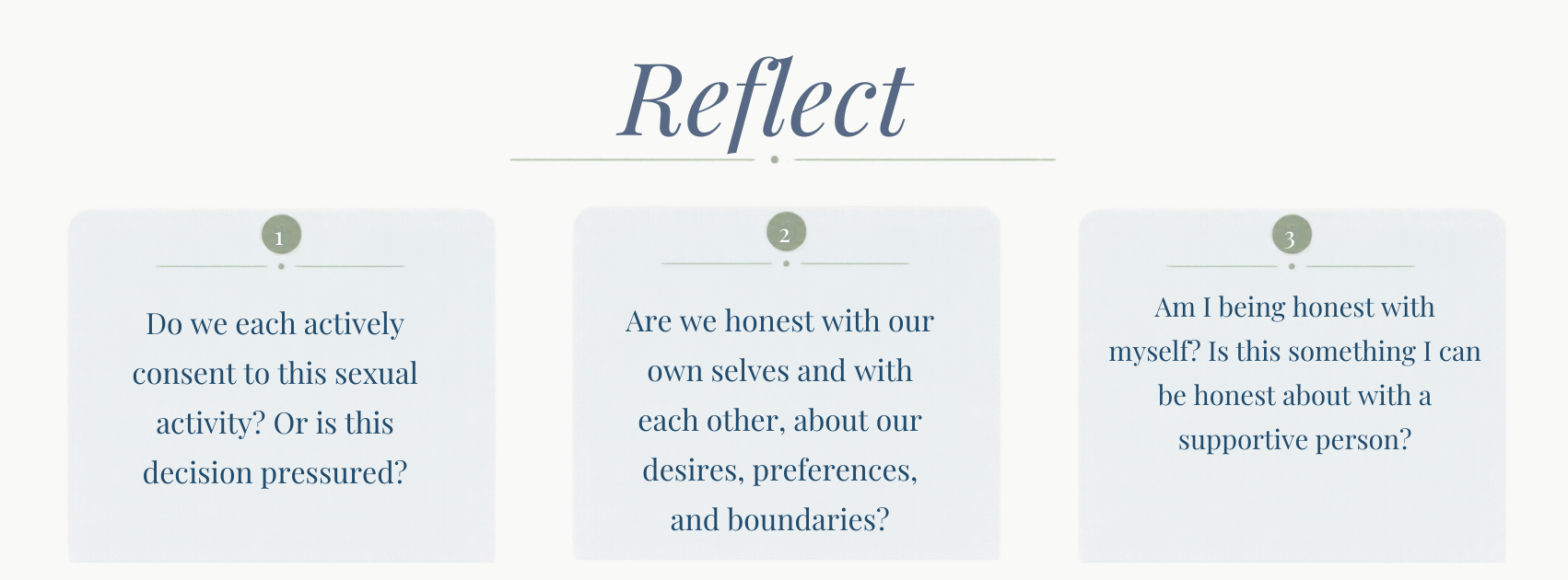
Three sections with questions about honesty, consent, and boundaries, titled 'Reflect' in elegant font at the top.
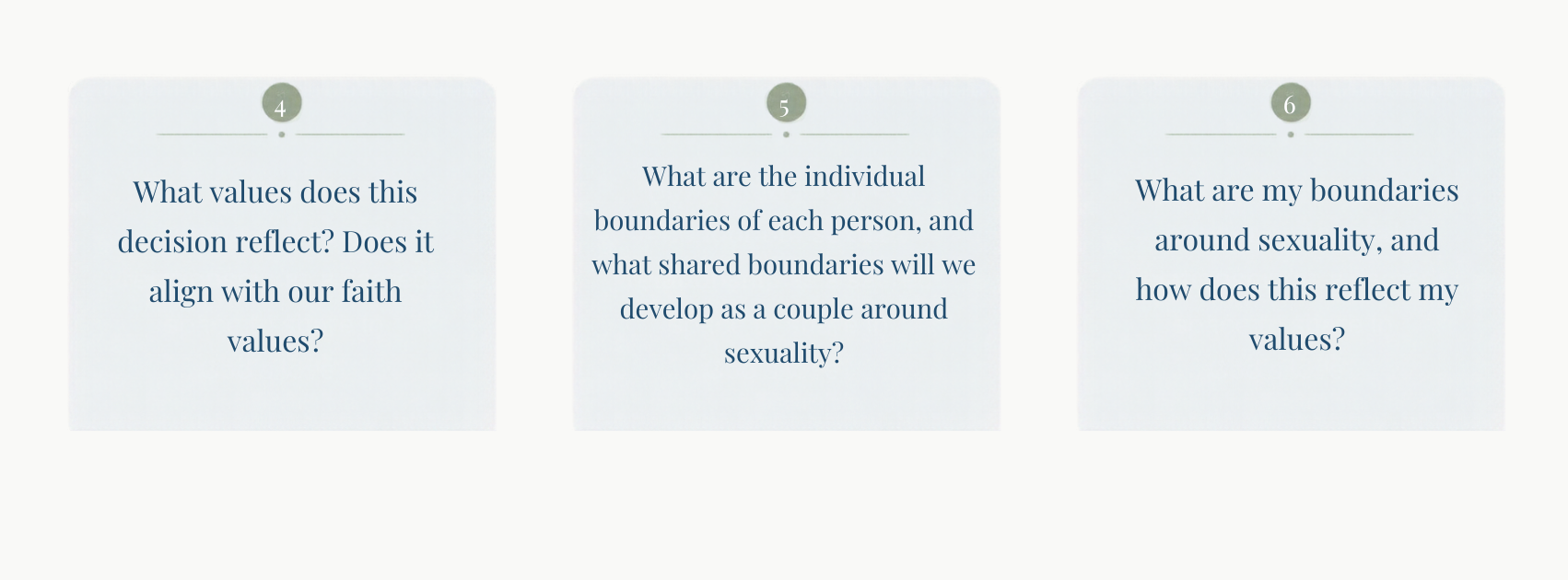
Three rectangular cards with rounded corners, numbered 4, 5, and 6, containing questions about values, boundaries, and sexuality, displayed on a light background.

What other questions might you ask?

Curious about our sources?

View
  1. Whittington E. Rethinking consent with continuums: sex, ethics and young people. Sex Educ. 2021;21(4):480-496.
  2. The Harvey Institute. Six principles of sexual health [Internet]. [cited 2026 Sep 21]. Available from: https://www.theharveyinstitute.com/six-principles-of-sexual-health
  3. Martin B, Dalzen R. The art of receiving and giving: the wheel of consent. Eugene (OR): Luminare Press; 2021.
  4. Cloud H, Townsend J. Boundaries in marriage: understanding the choices that make or break loving relationships. Grand Rapids (MI): Zondervan; 2009.
  5. Gregoire SW, Lindenbach RG, Sawatsky J. The great sex rescue: the lies you've been taught and how to recover what God intended. Grand Rapids (MI): Baker Books; 2021.
  6. Sellers TS. Sex, God, and the conservative church: erasing shame from sexual intimacy. New York (NY): Routledge; 2017.
  7. McCarthy B, Ross LW, Metz M. The good enough sex model. In: Kleinplatz PJ, editor. New directions in sex therapy: innovations and alternatives. 3rd ed. New York (NY): Routledge; 2024.

A Gentle Reminder