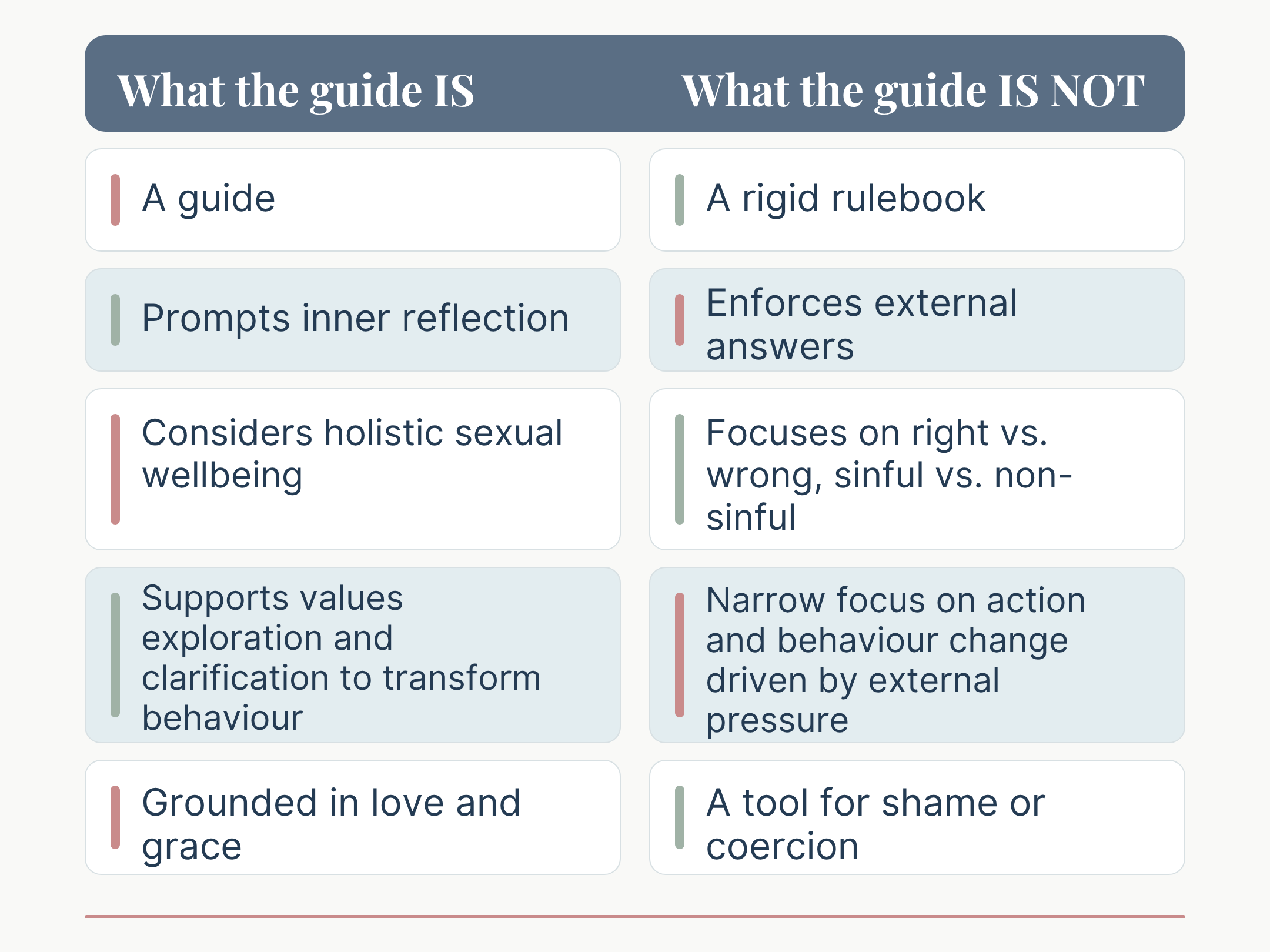
S - Sacred

We celebrate sexuality as a sacred, God-given gift. Our sexuality and its expression can be an act of worship.
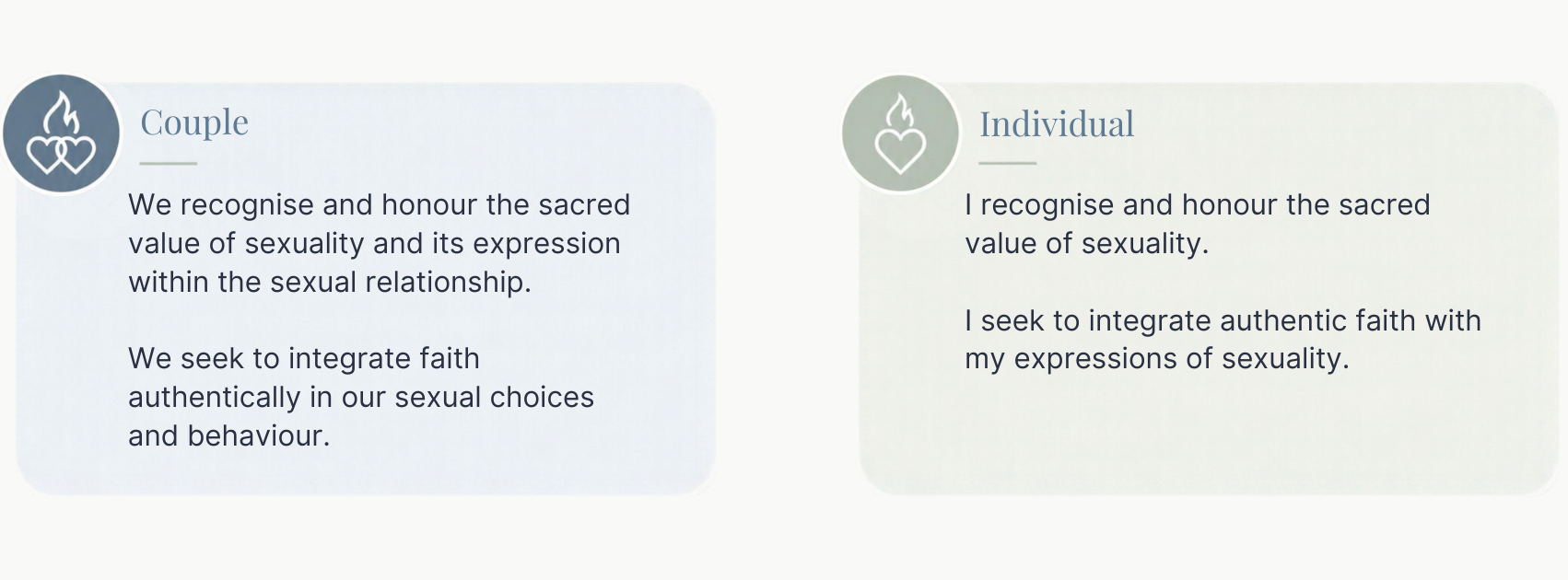
Comparison of two statements on recognizing and honoring the value of sexuality; one for couples and one for individuals.

Principles of Sacred

Sexuality as a Sacred Gift

Sexuality is an intentional good and generous gift from God, worthy of delight, respect and care.

Read more

Sacred means set apart by God for divine, higher purpose. Sacred is a blessing, a good and generous gift, worthy of delight, enjoyment and respect. While SACRED Intimacy is not positioned as a theological authority or faith educator, the faith stance at SACRED Intimacy is that sexuality and the expression of sexuality is deeply sacred. It is the belief at SACRED Intimacy that sexuality is intentionally designed by God, out of his love, reflects God, and that he delights in it. Sexuality and its expression can be an act of worship. (1, 2, 3)

Viewing sexuality as sacred is described as sexual sanctification in the literature; possessing divine character, transcendent significance, and sacredness. (1, 2, 3) Individuals and couples who internalise sexual sanctification experience significant psychological and relational benefits. This is in comparison to those with lower sanctification views or more legalistic or rigid views of sex. Those who see intimacy as holy and sacred report better communication, deeper emotional connection, and higher relationship satisfaction. (1, 2, 3)

In religious couples, viewing marital intimacy as an act of worship fosters deep connection and the experience of personal liberation within their marital boundaries. This is a counter to secular assumptions that religious boundaries are inherently restrictive. (3) Open sexual communication is the strongest bridge through which sexual sanctification elevates sexual satisfaction, passion, sexual mindfulness and orgasmic consistency.(1)

However, while sexual sanctification contributes to sexual wellbeing, this must be grounded in accurate sexual health knowledge. For those who experience sexual dysfunctions, higher levels of sexual sanctification can amplify distress when a manageable medical issue, is perceived as a sacred loss or spiritual crisis. (2, 3) This is why the S.A.C.R.E.D. Intimacy Guide integrates sexuality as sacred alongside other critical components of sexual wellbeing, and comprehensive sexuality education.

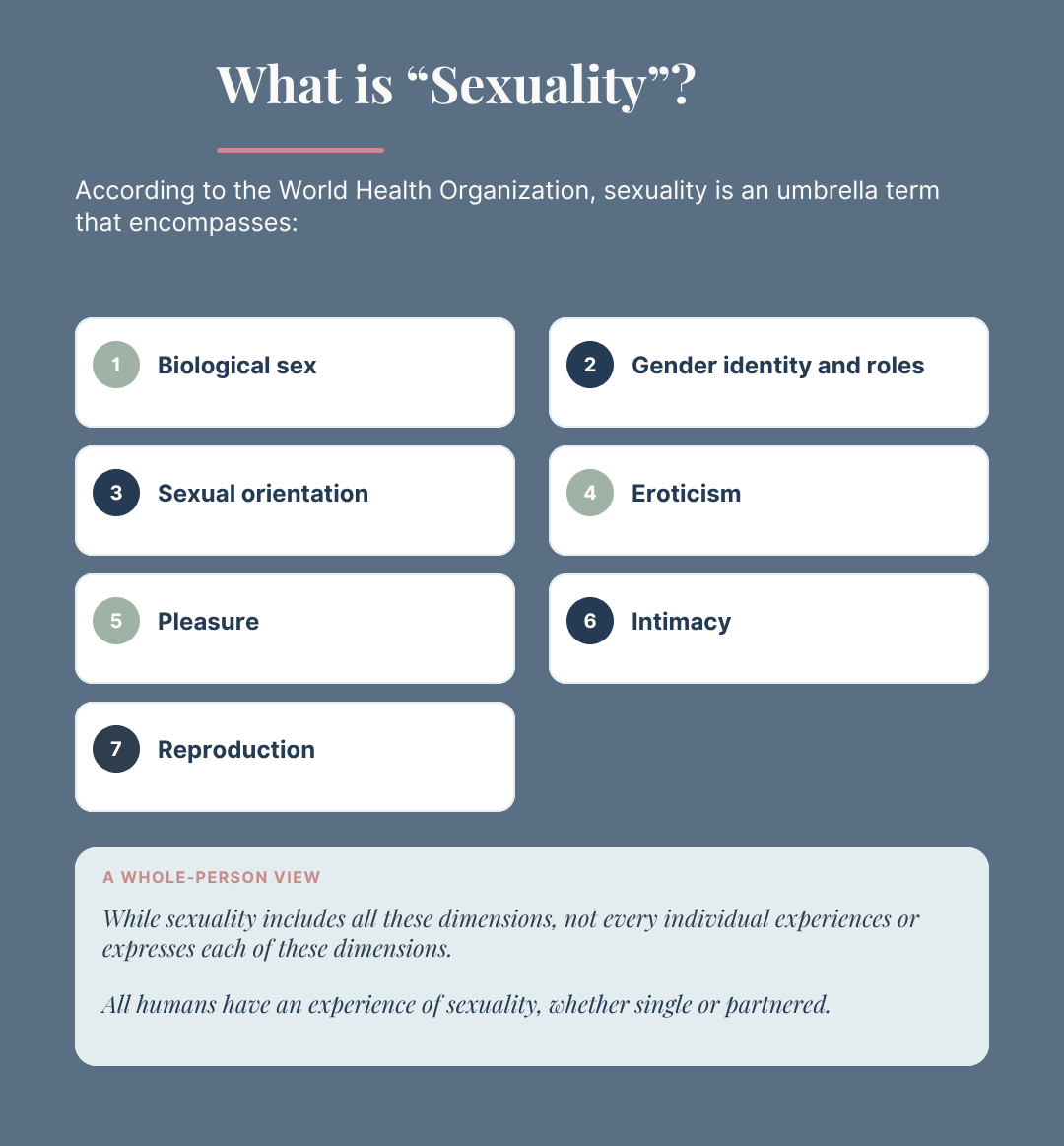
It is important to remember here the expansive definition of sexuality provided by the World Health Organisation, as this is what is being referred to as “sexuality”. At SACRED Intimacy there is the deep belief that whether single or in a relationship, sexuality is sacred.

The World Health Organization defines sexuality as:

“…a central aspect of being human throughout life (that) encompasses sex, gender identities and roles, sexual orientation, eroticism, pleasure, intimacy and reproduction. Sexuality is experienced and expressed in thoughts, fantasies, desires, beliefs, attitudes, values, behaviours, practices, roles and relationships. While sexuality can include all of these dimensions, not all of them are always experienced or expressed. Sexuality is influenced by the interaction of biological, psychological, social, economic, political, cultural, legal, historical, religious and spiritual factors.” (4)

What is important to highlight in this definition is that sexuality is expansive, and a part of the experience of every individual regardless of whether they are single, in a sexual relationship, or acting with or without sexual behaviour. The experience and expression of sexuality is holistic in that it is underpinned by biological, psychological, relational, societal, cultural, and spiritual factors. (4) This is understood as a biopsychosocial-spiritual approach to sexuality. (5) This biopsychosocial-spiritual, comprehensive, expansive understanding of sexuality is why the term “Holistic” Sexual Wellbeing is used in the SACRED Intimacy guide.

SACRED Intimacy holds the position that sexuality is intended to be a sacred gift and experience, while also acknowledging that not all sexual choices and behaviour are faith aligned. This is where it is essential to consider the foundation of faith, to explore and determine faith-aligned expressions of sexuality.

Authentic Faith Alignment

Sacred sexuality invites us to thoughtfully consider how our sexual choices and behaviour aligns with our faith.

Read more

SACRED Intimacy believes that Christians are called to be faithful and exercise responsibility in our sexuality whether single or in a relationship, which may look like exercising self-control or limiting certain areas of our sexual behaviour. Our faithfulness in this is a gift to God and a gift from God. In this we learn that God's faithfulness is bigger and stronger than ours.

SACRED Intimacy does not intend to be the theological or spiritual authority on matters of faith, but rather places the responsibility into the individual and couple’s hands to deeply wrestle with their theological underpinnings. SACRED Intimacy invites the whole range of Christian denominations to engage with its content, to wrestle with the holistic sexuality education, but to ultimately come to a decision based upon your own faith convictions.

As a pointer, one possible discernment tool considers the following:

  1. Scripture. Scripture reveals God’s character and purposes for human flourishing. It is the source of truth about God. At the same time, it must be understood well, without undue literalism and rigidity. What does scripture reveal about God’s intended purposes for human sexuality and sexual relationships? Have I explored scripture in its full context? (6)
  2. Tradition. What does the collective, historical wisdom of the Christian community have to offer, to ensure that scripture is not interpreted in isolation. Have I only considered my Christian tradition, or am I aware of the other potential Christian traditions and willing to be open to learning from them? While tradition is a valuable gift, we also must recognise that traditions do not automatically line up with God’s will. (6)
  3. Reason. All truth is God’s truth. This includes critical, rational, and scientific intelligence. Are we willing to also consider that this information is endowed to us by God, and explore how principles in modern science or psychology may in fact overlap with Biblical principles? We must recognise that the Bible teaches truth, but does not cover every contemporary issue or reality. (6)
  4. Experience. Our personal, lived experience and relationship with God. When we make decisions, can we openly invite God into that experience. Can we bring our choices and decisions fully into God’s presence with vulnerability, and allow God to speak into our hearts? We are willing to explore our experiences in the light of our faith and humbly learn from our experiences. (6)

Embodiment

Our bodies are an integral part of God's good design, deeply connected with our minds and spirits.

Read more

Included in the sacred design of our sexuality are our bodies. Our physical bodies are deeply integrated with our mind and spirit. Embodiment is to live in the full reality and unity of mind, body, and spirit; recognising the gift of our bodies. It is through our bodies that the mind and spirit touch the world. (7, 8) Within our sexual relationship there is the sharing of mind, body, and soul. (9)

In sacred sexuality we can live joyfully in our bodies, expressing ourselves confidently and freely with another, in God-honouring ways. Sacred sexuality rejects messaging that the body, sexuality, and sexual expression is inherently shameful or dirty. At the same time, sacred sexuality intentionally aims for expressions of sexuality that are faith aligned. (7, 10)

Grace-Filled

Sacred sexuality is grounded in grace rather than shame, creating space for forgiveness, healing, learning and transformation.

Read more

SACRED Intimacy holds to the belief that God is full of grace, forgiveness, healing, and transformation. While SACRED Intimacy aspires to the vision of sacred sexuality, there is grace for human imperfection, mistakes, errors, trauma, and the space for learning, healing, and growth. No matter your choices or hurts, and how you experience or express sexuality in the past, present, or future God is full of love for you full-stop. We all miss the mark, we can be walking contradictions, we can act in ways in complete opposition to our faith or values, and God is right there with full love. (11)

At the same time, SACRED Intimacy gently encourages you to consider growing in self-forgiveness, self-compassion, actively engage in personal transformation, and welcome informed and responsible decision making within your sexuality.

As it is the case with sexuality and all of its possible components, depending on whether a person is single or in a relationship, choosing to be sexually active or not, influences the degree to which these principles are expressed or not.
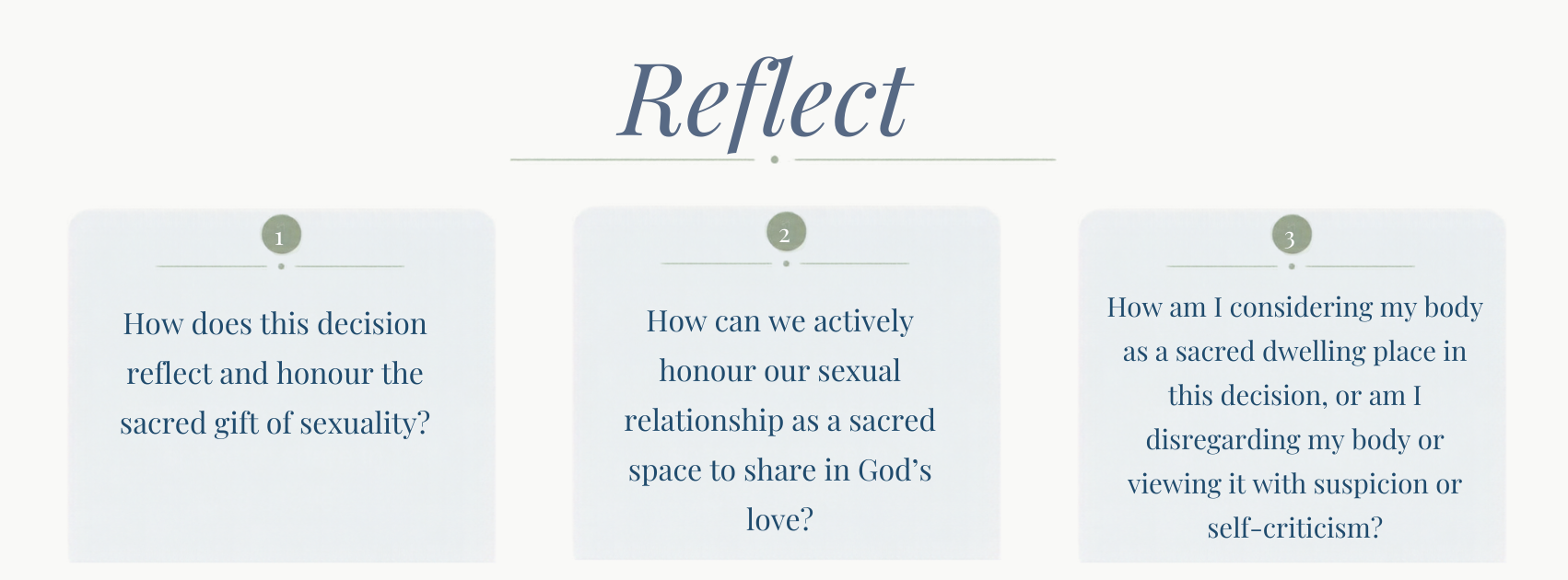
Three question cards with the title 'Reflect' at the top, each with a different question related to sexuality, body image, and spiritual reflection.
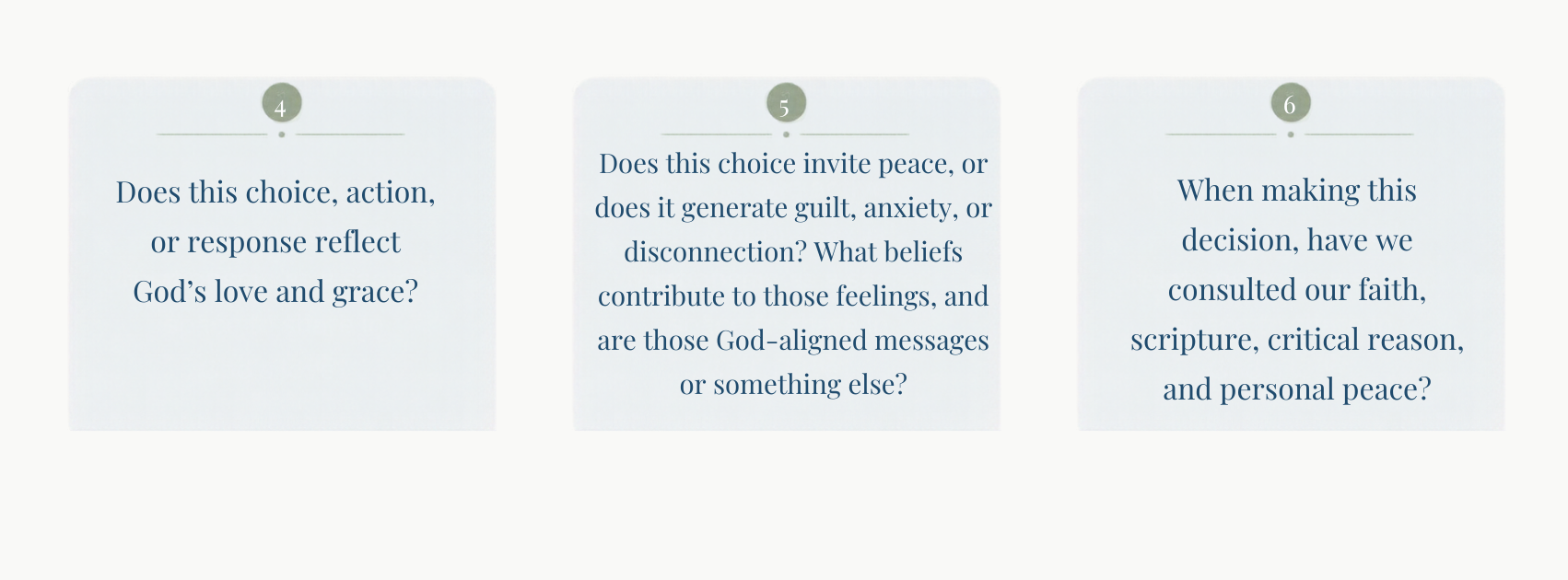
Three cards with reflective questions about faith, peace, and personal decision-making, numbered 4, 5, and 6.

What other questions might you ask?

Curious about our sources?

View
  1. Busby DM, Zollinger Allen C. Potential mechanisms through which sexual sanctification may influence sexual outcomes: sexual mindfulness, sexual intercourse frequency, sexual communication, and orgasmic consistency. J Sex Marital Ther. 2026;52(1):15-31. doi: 10.1080/0092623X.2025.2593329 .
  2. Lazar A, Gewirtz-Meydan A. The double-edged sword of sexual sanctification: moderation of the associations between sexual dysfunctions and sexual and psychological well-being. Arch Psychol Relig. 2024:1-23. doi: 10.1177/0084672424129578 .
  3. Leavitt CE, Allsop DB, Clarke RW, Marks LD, Dollahite DC. Sanctified sexual relationships in marriage: reflections from religious wives and husbands. Rev Relig Res. 2021;63(2):161-82. doi: 10.1007/s13644-020-00440-z .
  4. World Health Organization. Sexual health [Internet]. Geneva: World Health Organization; [date unknown] [cited 2026 Oct 16]. Available from: https://www.who.int/health-topics/sexual-health
  5. McCarthy B, Ross LW, Metz M. The good enough sex model. In: New directions in sex therapy: innovations and alternatives. 2024.
  6. Boaheng I. The Wesleyan quadrilateral and contemporary biblical exegesis. J Mother-Tongue Biblic Hermeneut Theol. 2020;2(3):87-95.
  7. Penner C, Penner JJ. The gift of sex: a guide to sexual fulfillment. Thomas Nelson; 2003.
  8. Sellers TS. Sex, God, and the conservative church: erasing shame from sexual intimacy. Taylor & Francis; 2017.
  9. Gregoire SW. The good girl's guide to great sex: and you thought bad girls have all the fun. Zondervan; 2012.
  10. Allender DB, Longman T III. God loves sex: an honest conversation about sexual desire and holiness. Grand Rapids (MI): Baker Books; 2014.
  11. Stringer J. Unwanted: how sexual brokenness reveals our way to healing. NavPress; 2018.

A Gentle Reminder