E - Enjoyable

We delight in the gift of sexual pleasure, recognising this experience is expansive across a lifetime. 
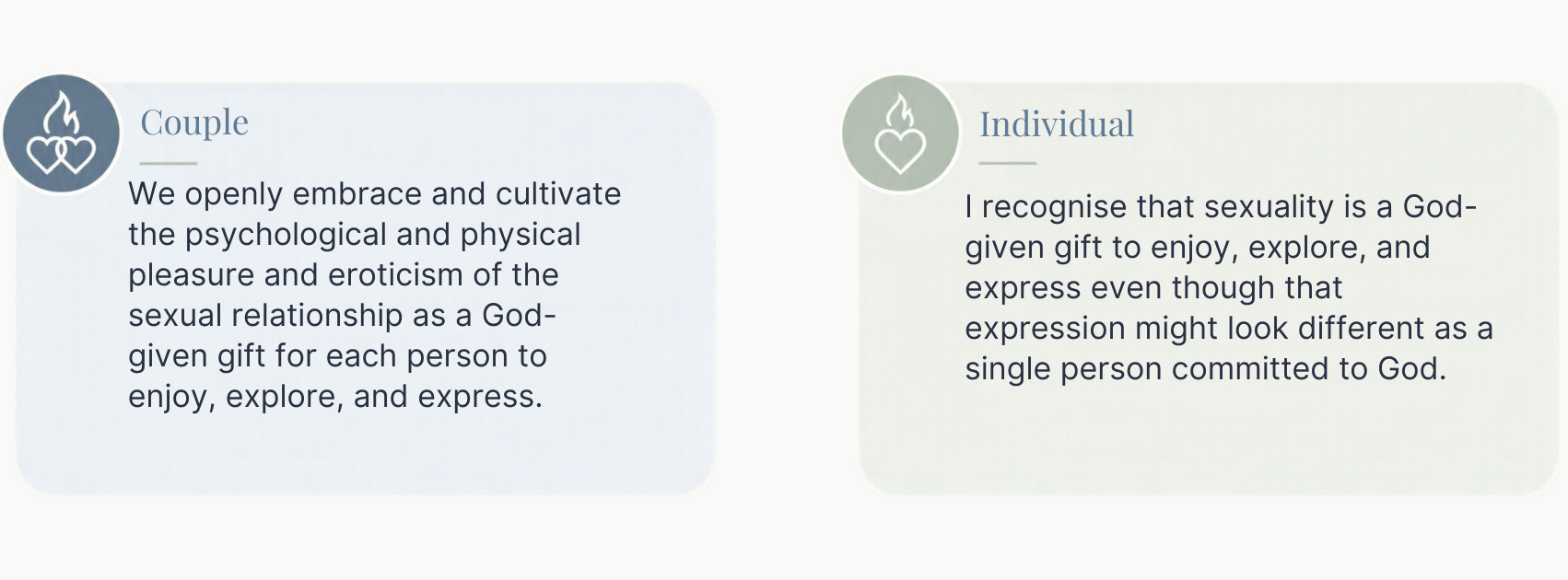
Comparison of views on sexuality: the left box for couples, emphasizing embracing and exploring sexual intimacy as a divine gift; the right box for individuals, endorsing personal sexual expression as a divine gift to enjoy and explore.

Pleasure for Both

Pleasure is something for each person to experience and share, and can include physical, emotional, mental and spiritual pleasure.

Read more

The sexual relationship can be a fulfilling source of mental, emotional, physical, and even spiritual pleasure. Pleasure is something for each to experience and to share in; it is of equal importance for each individual. (1-3)

Physically, pleasure can look like immense physical enjoyment, leading to orgasm. Psychological pleasure can also be derived from a deep sense of intimacy, excitement, playfulness, and fun. Spiritual pleasure might include the sense of connecting spiritually, or the values aligned experience and expression of sexuality as sacred. (1-3)

Eroticism

Eroticism is the vitalising experience of being sexually drawn towards the other.

Read more

Eroticism describes the quality of being sexually excited, aroused, and drawn towards the other. Eroticism often includes a sense of creativity, mystery, curiosity, playfulness, and novelty. (1,2)

The role of eroticism is sexual vitality; it is an energising force, a sense of aliveness, and is just as valid and important as a deep sense of connection. Whilst for some these qualities might seem opposed to each other, healthy sexuality is about learning to integrate both deep connection and eroticism. (1,2)

Excitement

Sexual arousal involves both mental and physical excitement.

Read more

Mental and physical excitement for sex is the experience of arousal. The mind responds with that sense of being “turned on” and enthusiasm for sexual activity, while the body experiences this through increased blood flow to the genitals, quickened heart rate, and rapid breathing. (1, 4)

If arousal is essentially excitement, arousal requires excitement. Sexual excitement can be incredibly subjective to the individual and the couple, drawing from elements of eroticism, pleasure, and intimacy. Whatever excitement looks like, it is a critical ingredient for sexual function and pleasure. (1, 4)

Exploration

A sexual relationship is something we continue to learn throughout life.

Read more

Just like establishing a relationship takes time to learn about each other and has an element of life-long learning, the sexual relationship requires an openness to growth and learning. (1, 2, 5)

Engaging in sexual intimacy or activity for the very first time, you will not fully understand or know your body or your partner’s body. An attitude of exploration, curiosity, openness, humility, and active communication will allow you to grow and strengthen the sexual relationship over time. It is for this reason that those aged 50 and over report higher levels of sexual satisfaction than those in their 20s and 30s. (1, 2, 5)

The 8 Components of Magnificent Sex

Magnificent sex is characterised less by performance and function and more by qualities such as presence, connection, intimacy, communication, authenticity, vulnerability, exploration and transcendence.

Read more

The 8 Components of Magnificent Sex describe qualities commonly found in peak sexual experiences. Importantly, magnificent sex is underpinned more by connection and vulnerability than performance or function, and not every component needs to be present for sex to be deeply satisfying. (2)

The eight components include being present, focused and embodied; deeply connected and in sync; experiencing sexual and erotic intimacy; communicating with empathy; being authentic and uninhibited; allowing vulnerability and surrender; exploring with playfulness and fun; and experiencing moments of transcendence, bliss, peace, transformation or healing.(2)

Together, these qualities remind us that enjoyable sex can be deeply connecting, playful, vulnerable, embodied and meaningful—not simply something that the body performs. (2)

The Good Enough Sex Model

Good Enough Sex makes room for the realities of sexual relationships by letting go of perfection, performance, and recognising the natural variability of sexual experiences across relationships and throughout life.

Read more

While SACRED Intimacy’s vision of God-gifted sexual intimacy is aspirational, it is also deeply rooted in reality. The Good Enough Sex Model (GES) aims for the good, while acknowledging and making room for the realities and challenges that can come with a sexual relationship. It actively rejects unrealistic standards about sexual intimacy. (1, 4)

GES encourages couples to challenge perfectionism, accept natural fluctuations in sexual experiences, treat sexual difficulties or “lapses” as opportunities for learning, and prioritise shared pleasure over performance, intercourse or orgasm. It recognises that bodies and sexual functioning change throughout life, and that satisfying sexual relationships adapt to these changes. (1, 4)

The model also encourages an expansive understanding of sex. Sexual intimacy can serve different purposes including pleasure, tension reduction, sexual self-esteem, relationship bonding and reproduction. Couples can draw upon different styles of arousal involving one’s own bodily pleasure, interaction with a partner, and erotic playfulness or novelty.(1, 4)

Ultimately, “good enough” sex takes pressure out of the sexual relationship. Rather than requiring every sexual encounter to be magnificent, it makes room for variability, flexibility, learning and shared pleasure. (1, 4)

Principles of Enjoyable

As it is the case with sexuality and all of its possible components, depending on whether a person is single or in a relationship, choosing to be sexually active or not, influences the degree to which these principles are expressed or not.
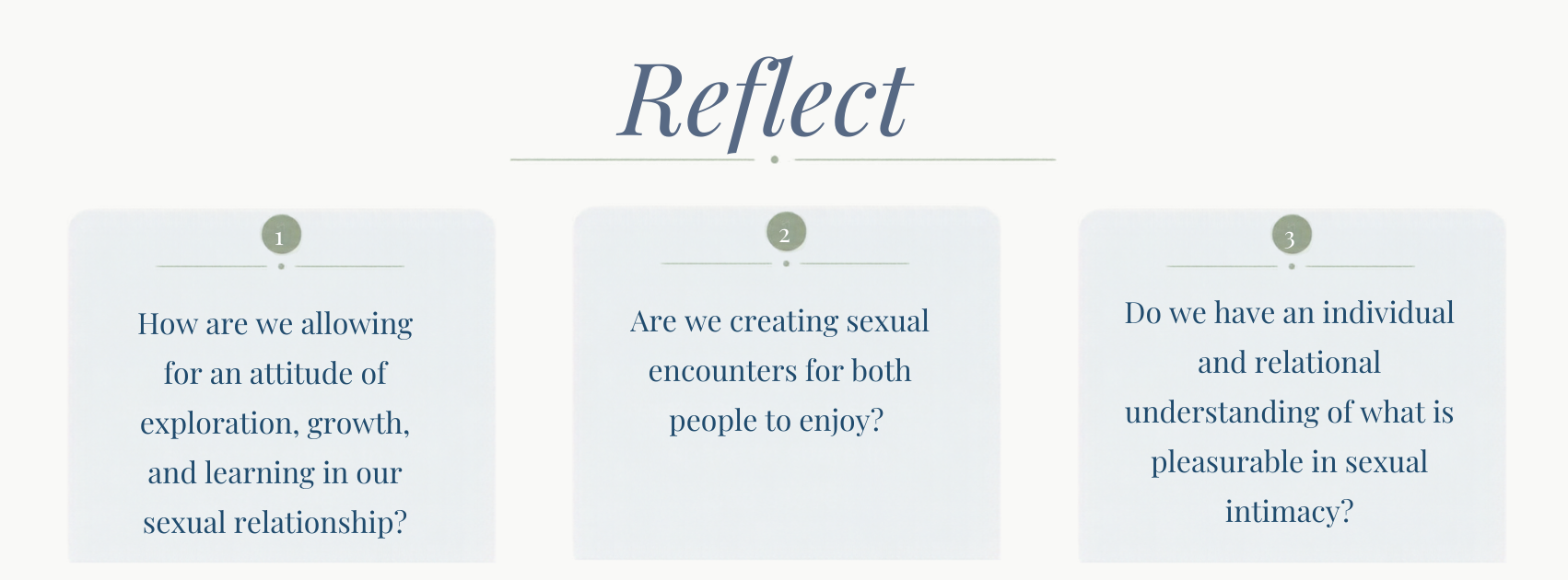

A webpage titled 'Reflect' with three numbered questions about sexual relationships and intimacy, centered on reflection about sexual attitudes, encounters, and understanding.
Three cards with questions about sexual intimacy, confidence, and expectations, numbered 4, 5, and 6.

What other questions might you ask?

Curious about our sources?

View
  1. McCarthy B, Ross LW, Metz M. The good enough sex model. In: Kleinplatz PJ, editor. New directions in sex therapy: innovations and alternatives. 3rd ed. New York (NY): Routledge; 2024.
  2. Kleinplatz PJ, Ménard AD, Paquet MP, Paradis N, Campbell M, Zuccarino D, et al. The components of optimal sexuality: a portrait of “great sex”. Can J Hum Sex. 2009;18(1-2):1-13.
  3. Mitchell KR, Lewis R, O'Sullivan LF, Fortenberry JD. What is sexual wellbeing and why does it matter for public health? Lancet Public Health. 2021;6(8):e608-e613.
  4. McCarthy B. Sex made simple: clinical strategies for sexual issues in therapy. Eau Claire (WI): PESI Publishing & Media; 2015.
  5. Kleinplatz PJ, editor. New directions in sex therapy: innovations and alternatives. 2nd ed. New York (NY): Routledge; 2012.

A Gentle Reminder