R - Relational

We nurture our sexual relationships, strengthening our connection with each other and ourselves.
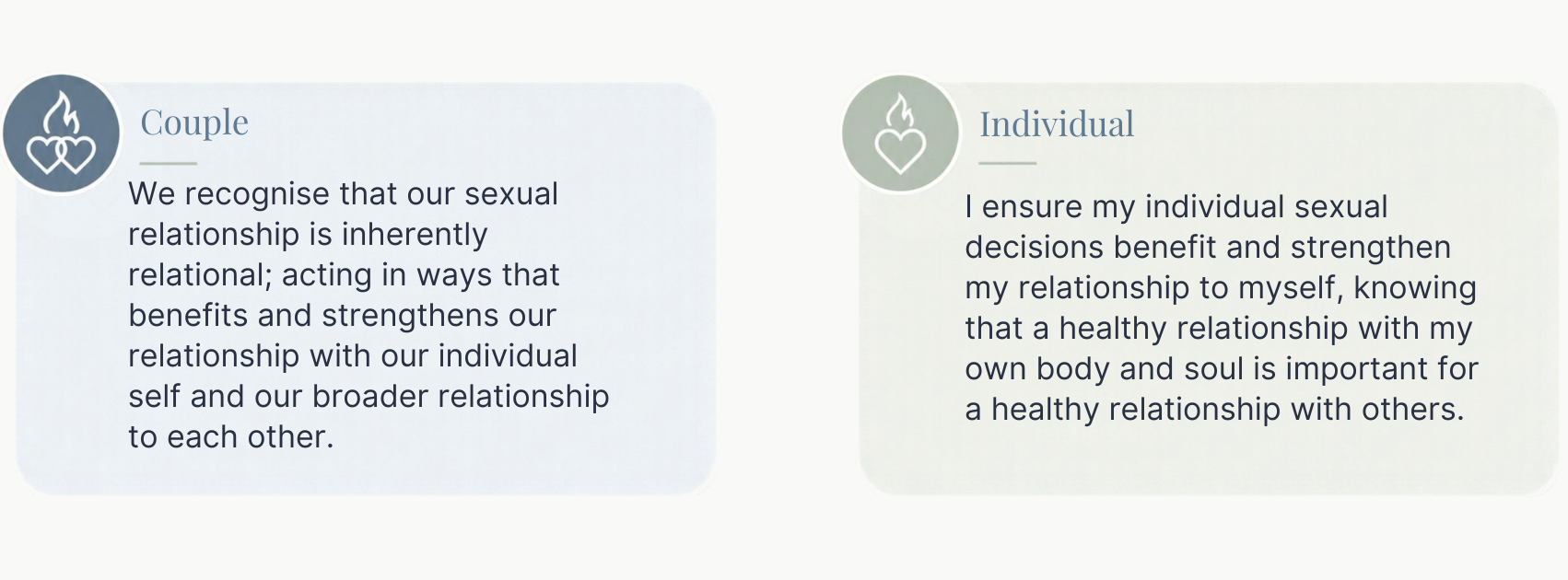
Comparison of relationship goals: one side discusses couples recognizing their sexual relationship's inherent relational nature and its benefits, while the other emphasizes individual healthy sexual decision-making and self-relationship.

Principles of Relational

The Sexual Relationship: More Than Just the Act of Sex

The sexual relationship is more than sexual activity itself; it is the shared way a couple communicates, connects, navigates differences, expresses vulnerability and creates sexual meaning together.

Read more

The sexual relationship is how the couple expresses their sexuality with each other, and builds a shared experience of sexuality. It includes communicating about the sexual relationship; navigating sexual differences; communicating during sexual activity; sharing sexual emotions, thoughts, desires, and fantasies; expressing vulnerability; connecting emotionally; sharing sexual meaning; and connecting through shared sexual behaviour and experiences. The sexual relationship itself, is supported by the foundation of the overall couple relationship. (1, 2)

Just like the broader relationship, it is important to be mindful of how patterns of disconnection, criticism, defensiveness, and avoidance can show up in the sexual relationship. (3) These dynamics can have a significantly negative impact, more than the physical act of sex or lack thereof.

Relationship with Self

Our relationship with our own sexuality includes how we relate to our bodies, sexual thoughts and feelings, values, experiences and sexual self. Developing self-knowledge, acceptance and compassion within our sexuality can support sexual wellbeing and how we connect with others.

Read more

Not only do we have a relationship with others, we have a relationship with our own self. When it comes to sexuality, it is important to consider our relationship to our bodies, relationship with our own thoughts and feelings about sexuality, relationship with our experience and expression of sexuality. This might look like sexual self-esteem, sexual self-knowledge, self-acceptance, being comfortable in your own body and skin. (4, 5)

A positive relationship with one’s own sexuality contributes to sexual wellbeing, regardless of relationship status or sexual activity. It may require self-forgiveness for past sexual experiences, or healing sexual shame. (4, 6) How an individual’s relationship with their own sexuality is expressed may be different from individual to individual, influenced by one’s values.

Whether single or in a romantic relationship, a person’s relationship with their sexuality has ripple effects into their friendships, family, and community. (7)

Relationship with the Other

Whether single, dating, or in a committed relationship, our sexuality both influences and is influenced by our relationships.

Read more

In a committed romantic relationship it is important to consider the sexual relationship sits within the broader context of the overall relationship. Just as the overall relationship influences the sexual relationship, the sexual relationship can impact the relationship as a whole.

In healthy relationships, the sexual relationship has a vitalising effect on the overall relationship, nurtured by the overall love, trust, commitment, and emotional intimacy in the overall relationship. In healthy relationships, the vitalising, positive influence of a healthy sexual relationship is approximately 15-20%. (3)

In contrast, a dysfunctional sexual relationship has a disproportionately negative impact on a couple relationship. In unhappy couples, a dysfunctional sexual relationship can contribute towards 50-70% of a couple’s overall relationship distress. (8) In a healthy relationship, sexual activity is just one of many things that adds to the overall couple satisfaction. Whereas, in an unhappy relationship a conflicted sexual relationship can be a major focus of dissatisfaction.

In a single context, it is important to consider that an individual’s relationship with their own sexuality, can still have an influence on how they interact with and relate to others in the broader context of friendship, family, and community relationships. A positive relationship with sexuality can support an individual in how they interact with others, whereas a negative sense of sexuality may be a barrier in relating to others. (5)

Given that sexuality is an integral part of human identity, a positive relationship with this part of our humanness leads to more integration and confidence, allowing us to engage deeply and authentically. (7) On the other hand, conflict within our sexuality such as internalised negative sexual attitudes or compulsive sexual behaviours, can contribute to shame, secrecy, and avoidance, taking away presence, focus, and connection from everyday relationships such as friendships. (9)

Shared Decision Making

A healthy sexual relationship is co-created, with both people having an equal voice in shaping their shared sexual experiences.

Read more

Given the relational nature of the sexual relationship, shared decision making is essential. The couple collaborates to become a sexual team, co-creating experiences with equal voice. Sexual expression is not just about one person focusing on solely their desires; both people are given a say in the couple’s sexual relationship. (1)

As it is the case with sexuality and all of its possible components, depending on whether a person is single or in a relationship, choosing to be sexually active or not, influences the degree to which these principles are expressed or not.
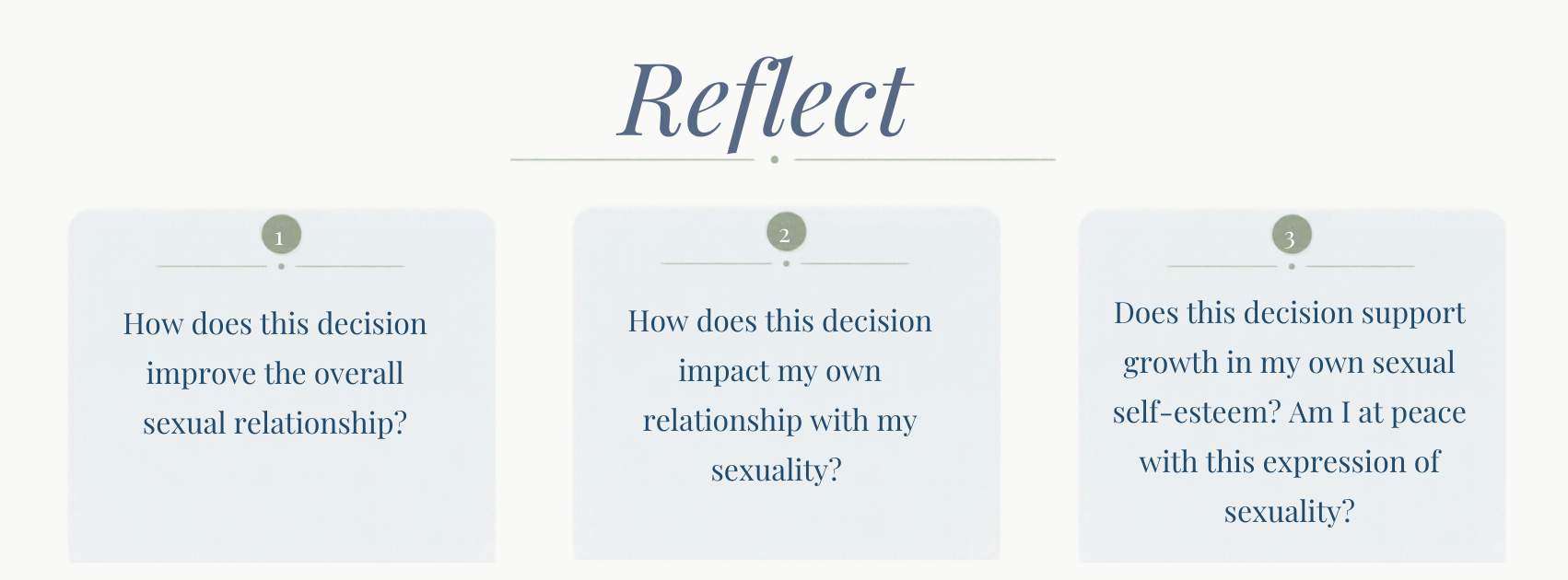
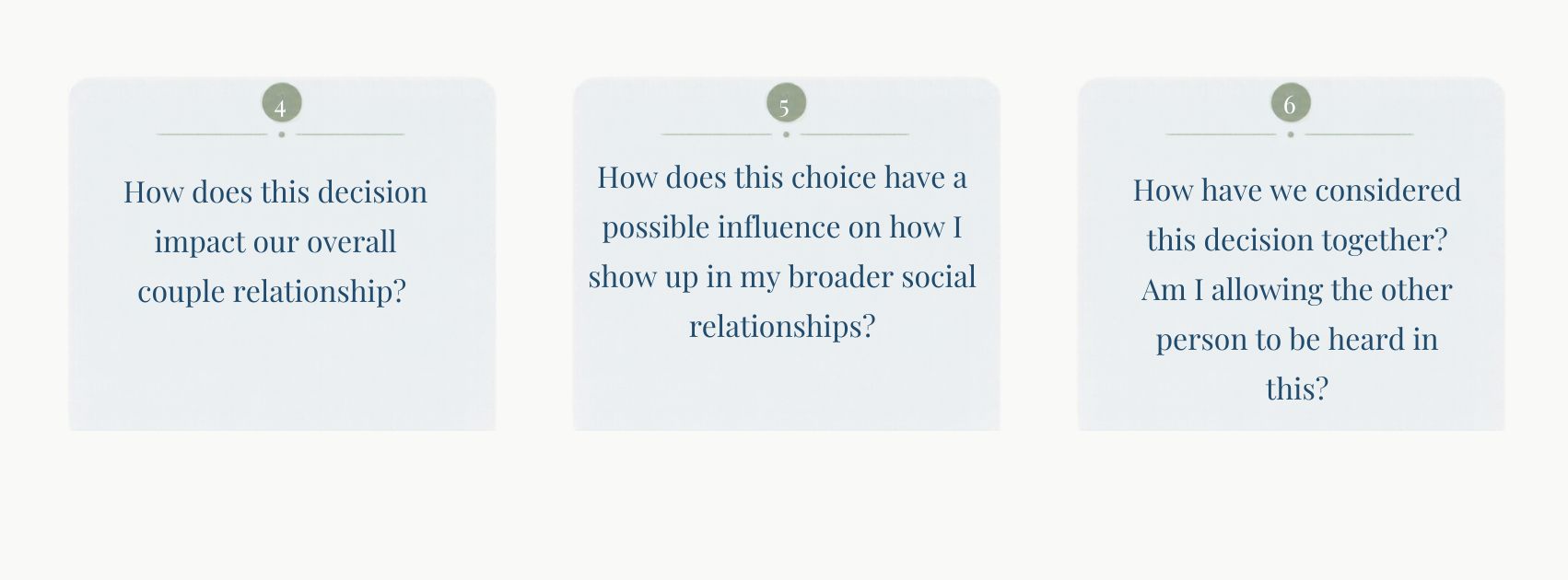
A page titled 'Reflect' with three questions about decision-making and sexual self-esteem, arranged horizontally.
Three white cards with questions about decision-making and social relationships, numbered 4, 5, and 6, with small green circles at the top of each card.

What other questions might you ask?

Curious about our sources?

View
  1. McCarthy B, Ross LW, Metz M. The good enough sex model. In: Kleinplatz PJ, editor. New directions in sex therapy: innovations and alternatives. 3rd ed. New York (NY): Routledge; 2024.
  2. Gambescia N, Weeks GR, Hertlein KM. A clinician's guide to systemic sex therapy. 2nd ed. New York (NY): Routledge; 2015.
  3. McCarthy B. Sex made simple: clinical strategies for sexual issues in therapy. Eau Claire (WI): PESI Publishing & Media; 2015.
  4. Kleinplatz PJ, Ménard AD, Paquet MP, Paradis N, Campbell M, Zuccarino D, et al. The components of optimal sexuality: a portrait of “great sex”. Can J Hum Sex. 2009;18(1-2):1-13.
  5. Mitchell KR, Lewis R, O'Sullivan LF, Fortenberry JD. What is sexual wellbeing and why does it matter for public health? Lancet Public Health. 2021;6(8):e608-e613.
  6. Ford JV, Corona Vargas E, Finotelli I Jr, Fortenberry JD, Kismödi E, Philpott A, et al. Why pleasure matters: its global relevance for sexual health, sexual rights and wellbeing. Int J Sex Health. 2019;31(3):217-230.
  7. Lehmiller JJ. The psychology of human sexuality. 3rd ed. Hoboken (NJ): John Wiley & Sons; 2023.
  8. Resnick S. Body-to-body intimacy: transformation through love, sex, and neurobiology. New York (NY): Routledge; 2018.
  9. Penner C, Penner JJ. The gift of sex: a guide to sexual fulfillment. Nashville (TN): Thomas Nelson; 2003.

A Gentle Reminder