
At SACRED Intimacy, we use the terminology of “Active Consent” as a core component of Authentic Agreement.
Active Consent is the internal willingness to engage in sexual activity that is actively communicated and accurately interpreted. (1, 2) Active consent is a choice to participate that is voluntarily and freely given, expressed explicitly, informed, specific, and can be revoked at any time. (3) This choice represents the person’s internal willingness; their internal sense of agreement to participate in a behaviour. While active consent is a principle that is broader than just sexual activity, this article will explore active consent in the context of the sexual relationship.
Why is Active Consent Important?
Active Consent is essential for sexual and relational wellbeing. Research examining elements of Active Consent (such as internal agreement, consent communication, and positive approach goals) links these experiences to a range of positive sexual and relational outcomes, including:
- Maintaining and fuelling higher levels of sexual desire (4)
- Experiencing sexual and relational happiness and satisfaction for both partners (5)
- Significantly higher likelihood of experiencing orgasm when explicit verbal consent cues are used (2)
- Accurate interpretation of consent is associated with greater physical responsiveness, safety, comfort, and readiness (2)
- Feeling increased closeness, fun, satisfaction, passion, excitement, life satisfaction, and decreased daily relational conflict (4)
- Sustaining an increased sense of long-term commitment to each other (5)
If we consider the sexual relationship as a sacred gift to be enjoyed, the above sounds like a positive way to experience that gift! From SACRED Intimacy’s perspective, consent embodies the commandment of “love your neighbour as yourself” by recognising the Image of God in a partner and seeking their highest dignity and wellbeing.
SACRED Intimacy’s stance is that while sexual wellbeing includes more ingredients than just active consent, there can be no true sexual wellbeing without active consent.
What Happens Without Active Consent?
Without Active Consent, we enter the territory of compliance and pressure. While permission may be given, willingness may be reluctant, diminished, or absent.
In compliance, the freedom to choose may still be present; however, willingness is reluctant, and there may be an internal sense of pressure to engage. Under pressure, freedom to choose is becoming constrained externally (from a partner), and willingness may be diminished or absent. (3, 7, 12)
In the literature, related experiences are explored as unwanted consensual sex, avoidance motivated sex, or compliant sex. These concepts overlap but are distinct, and definitions vary across the literature.
Research examining reluctant, compliant, pressured or avoidance-motivated sexual participation has identified a range of potentially negative sexual and relational outcomes:
- Both partners experience relationship and sexual dissatisfaction, and lower sexual desire (4-6)
- Experience higher daily relationship conflict (4)
- Declines in relationship commitment and higher likelihood of relational breakdown (6)
- Higher experience of anxiety, shame, anger, and fear (7)
- Erodes a sense of sexual autonomy and body safety, generating trauma-like responses (6)
- Higher rates of lifetime risky sexual behaviour, less effective safer-sex or contraceptive practices in young adults (7)
- Women who engage in compliant sex are more likely to report subsequent sexual coercion or victimisation, demonstrating strong correlation between sexual compliance and subsequent sexual victimisation (7)
- In the long term, sexual frequency alone does not provide benefit, while compliant or pressured sex causes cumulative relational damage (5)
- Christian women who feel obligated to have sex are 37% more likely to experience sexual pain (8)
- Christian women frequently have difficulty experiencing orgasm when obligation messages are internalised (9)
- Obligation scripts in purity culture blur the line between free engagement and sexual coercion, which contributes to higher rape myth acceptance and the normalisation of spousal coercion or marital rape (10, 11)
While there may be a free choice to engage in sex compliantly, and some degree of choice under pressure, willingness is reluctant, diminished or absent. This leads to negative outcomes for both partners involved. SACRED Intimacy advocates for active consent as a non-negotiable principle in sexual and relational wellbeing.
If the sexual relationship is truly a sacred gift from God, it is SACRED Intimacy’s belief that a gift is designed to be good. The outcomes associated with compliant or pressured sex are anything but good.
Compliance may still involve freely chosen sexual participation, despite reluctant willingness. As pressure increases, however, freedom to choose becomes increasingly constrained. This can make the boundary between reluctant but freely chosen participation and participation in which freedom has been compromised increasingly difficult to identify. (3, 6)
It is important to recognise the danger in how this boundary can blur between consensual compliance, pressure, and non-consensual coercion. (3, 6) Coercion occurs where apparent agreement is obtained through influences that undermine a person's freedom to choose.
Asking “Was there consent?” is therefore not enough. We also need to ask:
“How do we foster and invite Active Consent?”
Sexual activity without freely given consent may constitute sexual assault under Australian law; legal definitions vary between jurisdictions.
We’re Married, Do We Need Active Consent?
Importantly, the literature highlights that relationship context or relationship status alone does not determine consent. Consent within long-term relationships can fluctuate from one sexual encounter to the next. In fact, relying on relationship status as evidence of consent risks overlooking or eroding a partner’s internal willingness. (2) Being in a committed relationship, having consented previously, or regularly having sex does not indicate consent to the sexual encounter happening now.
Active consent is also essential in long-term relationships, as both internal agreement and sexual desire typically decline over time. Engaging in sex with approach goals; intrinsic to SACRED Intimacy's concept of active consent, acts as a vital buffer to nurture and maintain ongoing sexual desire in long-term relationships. (2, 5, 13)
Active Consent therefore requires partners to remain attentive to internal willingness, communication and interpretation throughout the relationship, not simply assume consent because of the relationship itself.
Understanding The Consent Continuum
At its simplest, the SACRED Intimacy Consent Continuum can be understood as:
Active Consent — “I freely choose this for me, for you, for us.”
Compliance — “I’d prefer not to, but I’ll agree.”
Pressure — “I’m agreeing to make this stop.”
Coercion — “I feel fearful to say no.”
Force — “I have been robbed of choice.”
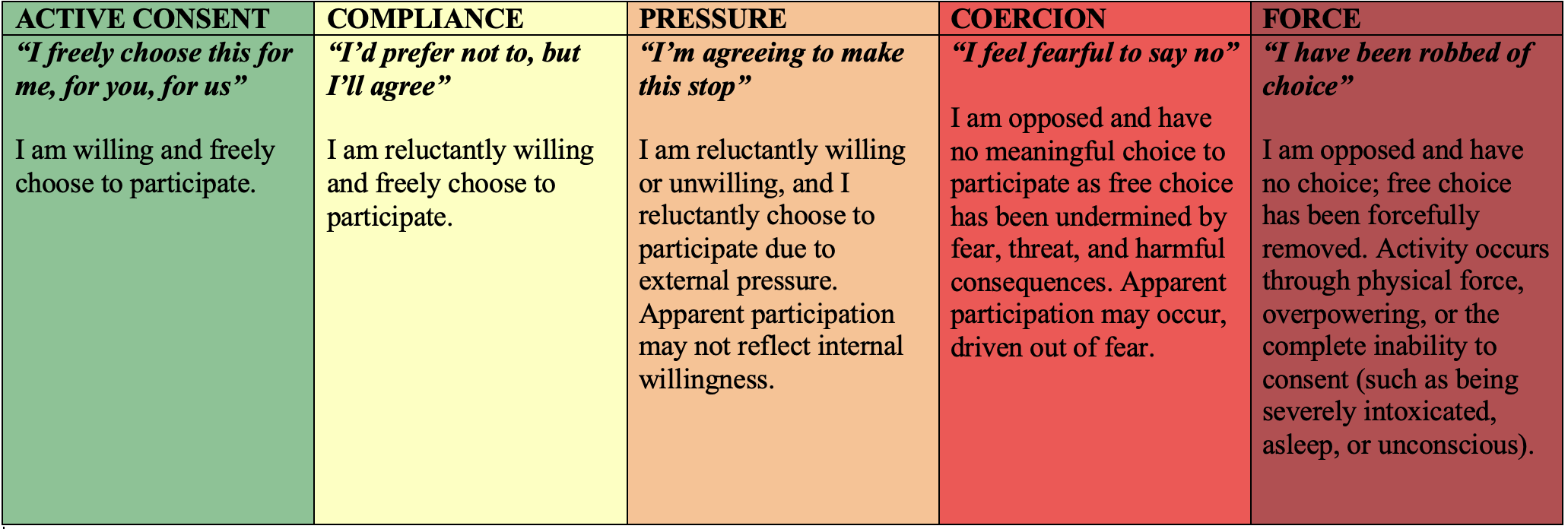
The Sacred Intimacy Consent Continuum
To see an expanded, full version of the continuum click here.
The continuum considers not only whether sexual activity occurs but also the person’s internal willingness, freedom to choose, goals for participating, communication, interpretation, and the relational dynamics surrounding the sexual interaction.
About this model: The SACRED Intimacy Consent Continuum is an educational framework informed by, but expands on existing consent continuums and research examining sexual consent, willingness, sexual compliance and sexual goals. The categories are designed to support reflection on the quality and freedom of sexual agreement and should not be interpreted as a legal assessment of consent.
SACRED Intimacy’s model for Active Consent draws upon the the Consent Continuum as attributed to the RDI network, the Consent Continuum Framework developed by Body Safety Australia, and academic literature on consent. (see reference 14, 15)
Understanding Active Consent
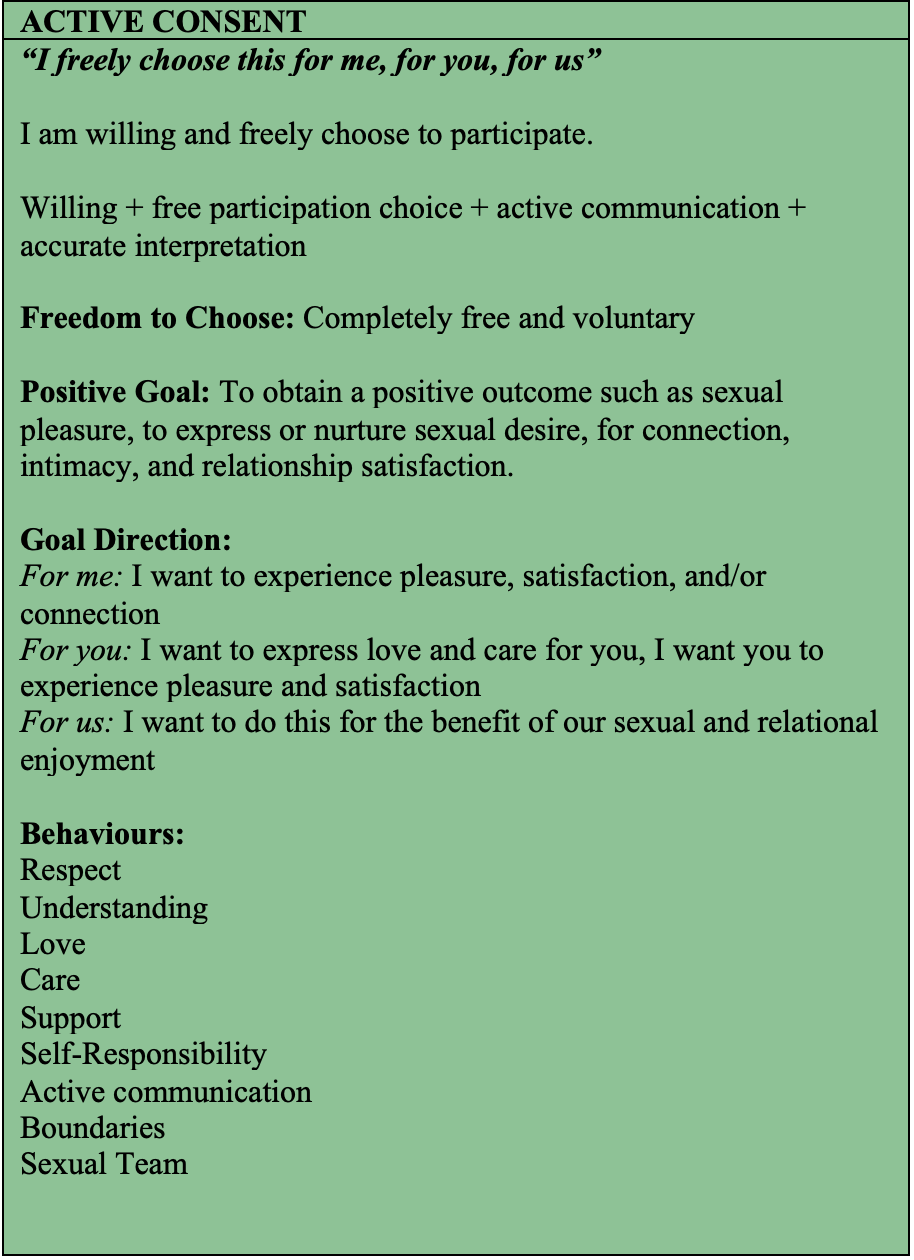
Active Consent has three core components: internal willingness, active communication, and accurate interpretation.
What is Internal Willingness?
Internal willingness is the free internal choice to engage in sexual activity. Internal willingness is comprised of physical response, safety and comfort, arousal, sense of agreement, desire, and readiness. No single component unilaterally represents consent on its own, but rather strength across these components contributes to overall strength of internal willingness. For these reasons, active consent is not a simple yes/no binary or a static, fixed concept. Active consent is dynamic, it can fluctuate in strength as these contributing factors change.
What about sexual desire (wanting) and willingness?
Internal willingness may accompany strong sexual desire, but sexual desire (in other words wanting sex), is not always necessary for willingness or the agreement to participate in sex. A person may experience internal willingness without initial sexual desire (wanting), because of willingness for connection or intimacy, or caring for and sharing pleasure with their partner is something they positively value, and because they know sexual desire (wanting) will emerge throughout sexual activity (known as responsive sexual desire). We see here that willingness is not the same as wanting. (1, 3) While wanting is not a pre-requisite for sexual willingness, it can certainly strengthen sexual willingness. In the context of a sexual relationship, sexual desire is important to nurture. If desire is consistently absent in willing sexual activity, this must invite curiosity and exploration. Engaging in sexual activity with absent desire can easily erode willingness over time and shift sexual activity into the territory of compliance. (1, 2, 6)
There are also times where a person may experience strong sexual desire but is unwilling, actively opposes or does not agree to consent to sexual activity. A person’s sexual desire alone should never be taken as evidence for or against consent to sexual activity. (12) An example of this could be in an early dating context where sexual desire is strong, and there is the want to be sexual, but the unwillingness, or absent agreement to participate in sexual activity. Another example could be experiencing sexual desire to someone other than a partner, and actively choosing not to participate sexually with them.
Why do we engage in sex?
Approach goals are another important concept to understand when it comes to active consent. If active consent includes the internal willingness to engage, we need to ask why someone chooses sexual activity. Approach goals describe the positive reasons that a person may choose to engage in sex. Approach goals are focused on obtaining positive outcomes such as feelings of emotional closeness, to enhance intimacy, to experience physical pleasure and connection. (5)
Approach sexual goals can be both self-focused and other-focused. Self-focused is about pursuing personal sexual pleasure, feeling positive about self, and this predicts higher daily sexual desire. Other-focused approach sexual goals include expressing love, caring for a partner, and promoting intimacy. These other-focused approach sexual goals also predict higher daily sexual desire. While sexual desire naturally decreases over time in a long term relationship, strong approach goals buffer against this decline. (13) In the SACRED Intimacy model of consent, this is simply described as Positive Goal.
What is Active Communication?
Consent that is actively communicated includes behaviour and verbal cues both explicit and implicit. The quality of exchange of communication and contextual cues between partners is essential for the accurate interpretation of consent. (1, 2) While communication can be implicit, SACRED Intimacy suggests that active consent includes explicit communication through words and aligning behaviour to communicate consent.
Active communication throughout a sexual encounter might sound like:
“How does my hand feel there?”
“What about when I kiss you here?”
“How do you want me to explore you right now?”
“I like when you touch me like this”
“Can you go slower”
“What if we tried this position?”
What is Accurate Interpretation?
Accurate interpretation is the ongoing communicative exchange between partners throughout sexual activity to determine consent. (2) Active consent recognises that consent is dynamic and can change throughout a sexual encounter. This is why accurate interpretation and active communication are essential throughout a sexual encounter.
Understanding Compliance
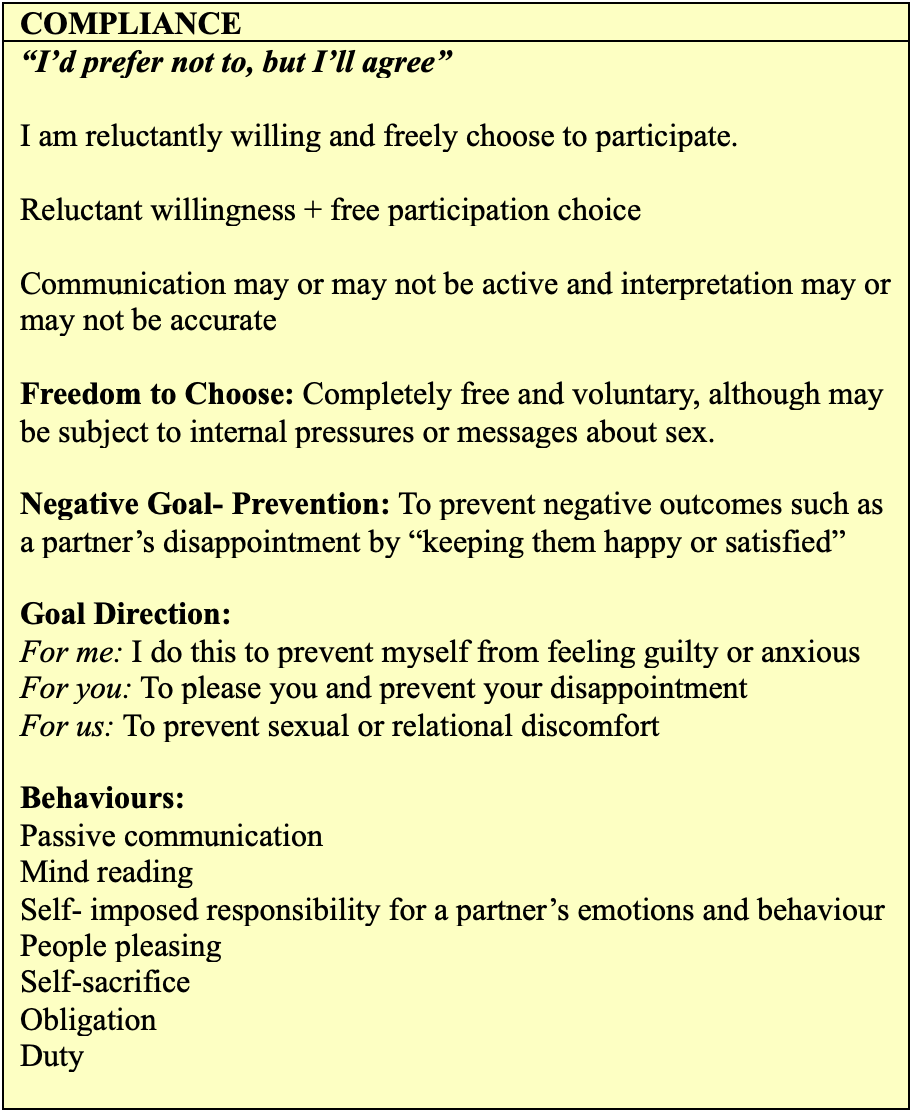
Compliance is engaging in sexual activity that may be unpreferred but is still freely chosen. In compliance, a person retains the freedom to say yes or no, but may choose to say yes to please a partner and prevent their disappointment. (12) Compliant sex is often founded on messages about sexual obligation and duty that are then internalised.
Compliance is characterised by what researchers describe as avoidance goals. SACRED Intimacy separates two types of avoidance goals, one with the aim to prevent a negative outcome, and the other to stop an already occurring negative outcome.
Compliance is focused on preventing a negative outcome. In the SACRED Intimacy model this is referred to as the Negative Goal - Prevention. An example of this is to prevent disappointment in a partner by “keeping them sexually satisfied”.
Understanding Pressure
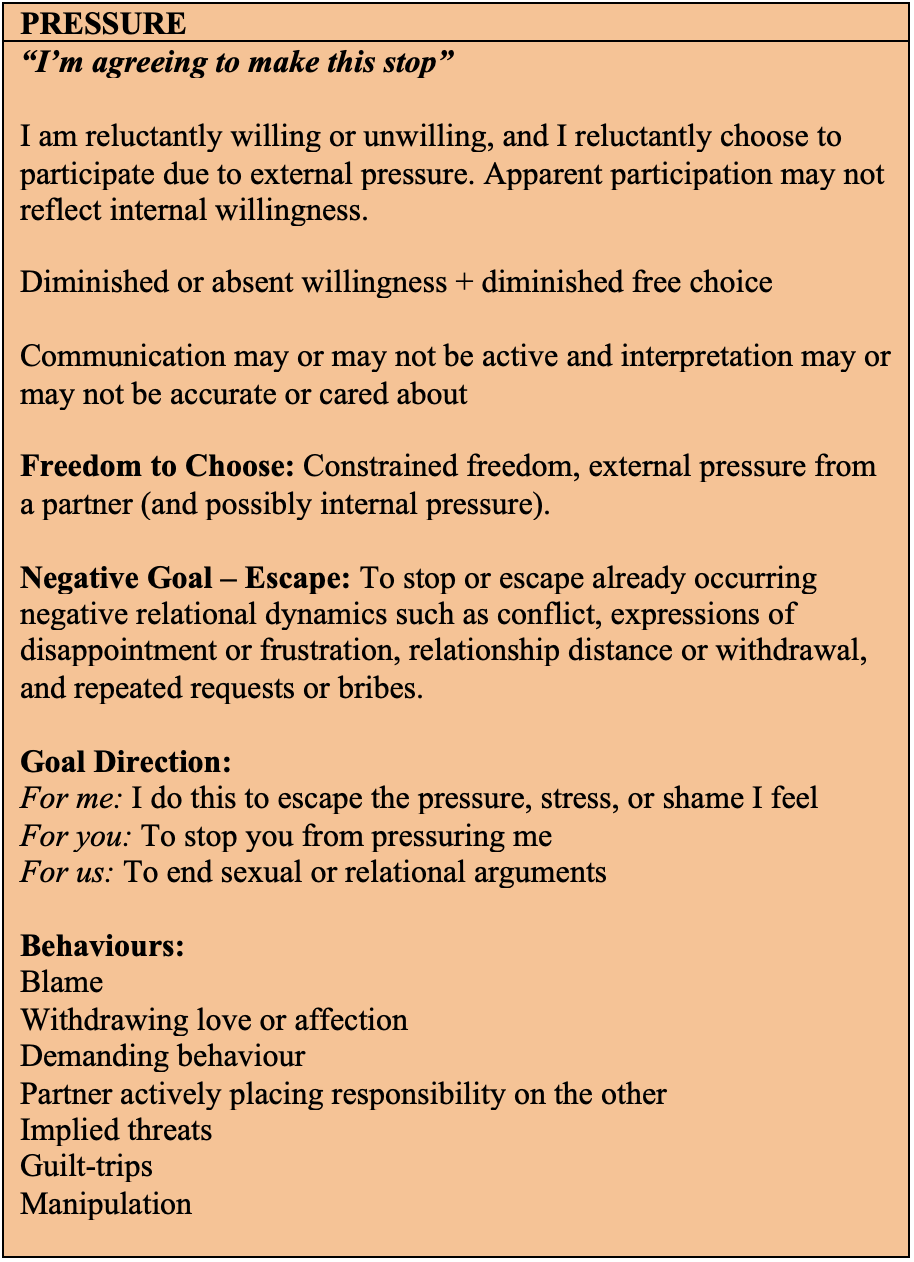
Pressure is when there is diminished or absent willingness to engage in sexual activity, freedom to choose is constrained, but agreement is given to escape or relieve an already occurring negative outcome. This reflects the idea of an avoidance goal described as Negative Goal - Escape in the SACRED Intimacy model. Because of pressure, a person may engage sexually to escape or stop relationship conflict, repeated demands, or relationship distance.
Understanding Coercion
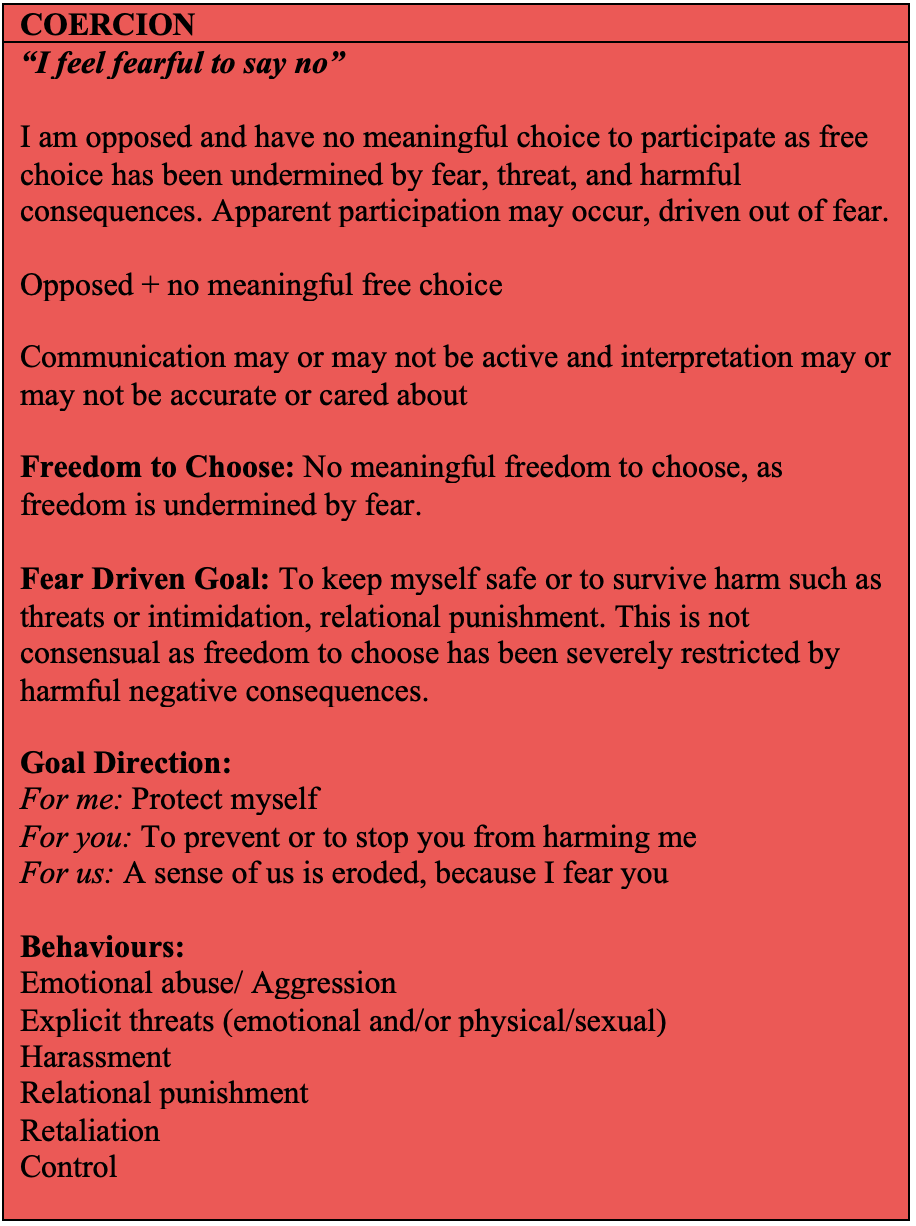
Coercion is when a person is opposed to engaging in sexual activity, meaning they do not consent, however, may seemingly participate in sexual behaviour because their free choice had been undermined by fear, threat, or harmful consequences. This is non-consensual, fear-driven behaviour. (12) Sexual coercion is a form of sexual violence.
Understanding Force
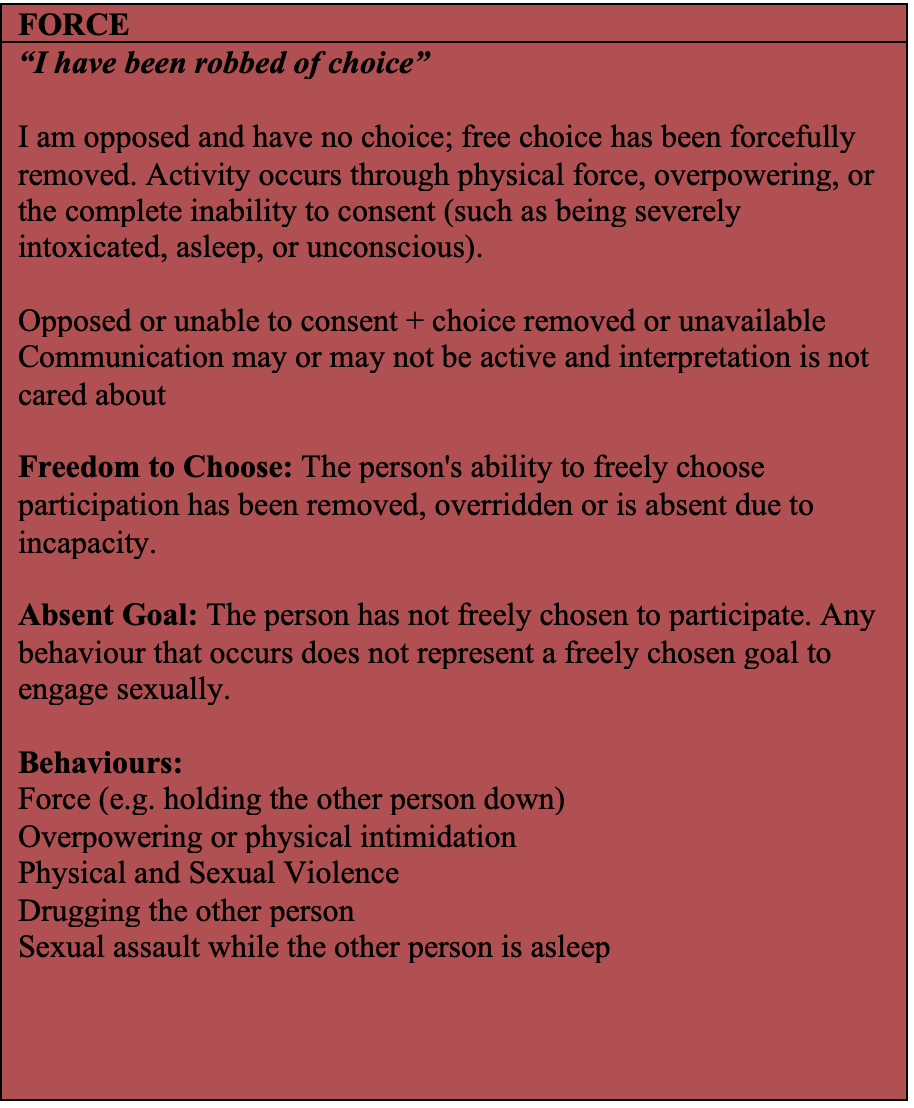
Force is when a person is opposed to engaging in sexual activity, meaning they do not consent, but their choice is actively removed through physical force, violence or overpowering. (14) There are also instances where a person may be incapacitated and unable to consent. Sexual behaviour in these instances is not consensual and may or may not use force. This is not sex, it is sexual violence.
From Obligation to Sacred Flourishing
When we replace scripts of obligation, fear, or compliance with Active Consent, sex is transformed. Sex is no longer a spousal debt to be paid or a conflict to be managed. Sexual activity becomes sexual intimacy; it becomes a space of safety, connection, mutual honour, and shared pleasure, and joy.
Active Consent is not about adding restrictive rules to marriage; it is about creating the relational freedom necessary for authentic passion and connection to thrive. By honouring your own and your partner’s agency, listening attentively to their internal willingness, and nurturing positive sexual goals together, you reflect the love and dignity at the heart of God’s design for intimate relationships.
Reflecting Together as a Couple
Take some time individually or together as a couple to reflect on where your relationship sits and how you can invite more Active Consent into your marriage:
Checking In on Motives: When we choose sexual intimacy, what are our primary goals? Are we driven by positive sexual goals (seeking closeness, love, physical and sexual enjoyment, care for each other, and mutual pleasure) or negative – prevention or negative – escape goals (preventing disappointment or stopping escalating conflict)?
Nurturing Communication: How comfortable do we feel using explicit verbal check-ins before and during sex? How can we make it safer for each other to share honest feelings or say, "Not right now, but I love you"?
Curiosity Over Expectation: If sexual desire feels low or absent for one of us, how can we bring curiosity and empathy to that experience rather than expectation or guilt?
Seeking Support
Unlearning years of internalised duty or navigating long-standing patterns of compliance can take time and gentle care. If you recognise patterns of pressure, obligation, or sexual pain in your relationship, know that you do not have to navigate this alone. Rebuilding trust and active consent is possible with the guidance of a faith sensitive, relationship or sex therapist.
If this has raised safety concerns about your relationship: If you recognise experiences of intensifying sexual pressure, coercion or force in your relationship, support is available. If you are in immediate danger, contact emergency services on 000 (Australia).
1800RESPECT — 1800 737 732 (National Hotline)
DVConnect Womensline — 1800 811 811 (QLD based)
DVConnect Mensline — 1800 600 636 (QLD based)
Click for References
- Willis M, Jozkowski KN, Bridges AJ, Veilleux JC, Davis RE. Assessing the within-person variability of internal and external sexual consent. J Sex Res. 2021;58(9):1173-83.
- Willis M, Murray KN, Jozkowski KN. Sexual consent in committed relationships: a dyadic study. J Sex Marital Ther. 2021;47(7):669-86.
- Muehlenhard CL, Humphreys TP, Jozkowski KN, Peterson ZD. The complexities of sexual consent among college students: a conceptual and empirical review. J Sex Res. 2016;53(4-5):457-87.
- Impett EA, Peplau LA, Gable SL. Approach and avoidance sexual motives: implications for personal and interpersonal well-being. Pers Relatsh. 2005;12(4):465-82.
- Muise A, Impett EA, Desmarais S. Getting it on versus getting it over with: sexual motivation, desire, and satisfaction in intimate bonds. Pers Soc Psychol Bull. 2013;39(10):1320-32.
- Sowan W, Gewirtz-Meydan A, Abboud RJ, Engdau S, Dror R. Sexual compliance in committed relationships: motives, prevalence, and relational impact. Fam Relat. 2026:1-11. doi:10.1111/fare.70290 .
- Impett EA, Peplau LA. Sexual compliance: gender, motivational, and relationship perspectives. J Sex Res. 2003;40(1):87-100.
- Estrada LL. Clinical considerations of the evangelical purity movement's impact on female sexuality. J Sex Marital Ther. 2022;48(2):121-32.
- Stevenson R, Hiebert D. Silenced desire: personal effects of the evangelical construction of female sexuality. J Sociol Christ. 2021;11(2):59-83.
- Cronan K. An analysis of evangelical purity culture and gender-based beliefs [dissertation]. Virginia Beach (VA): Regent University; 2023.
- Sawatsky J, Lindenbach R, Gregoire SW, Gregoire K. Sanctified sexism: effects of purity culture tropes on White Christian women's marital and sexual satisfaction and experience of sexual pain. Sociol Relig. 2025;86(4):519-43.
- Peterson ZD, Muehlenhard CL. Conceptualizing the "wantedness" of women's consensual and nonconsensual sexual experiences: implications for how women label their experiences with rape. J Sex Res. 2007;44(1):72-88.
- Impett EA, Strachman A, Finkel EJ, Gable SL. Maintaining sexual desire in intimate relationships: the importance of approach goals. J Pers Soc Psychol. 2008;94(5):808-23.
- Centre for Excellence in Rural Sexual Health. Consent [Internet]. Melbourne: The University of Melbourne; [date unknown] [cited 2026 Oct 10]. Available from: University of Melbourne .
- Body Safety Australia. The consent continuum [Internet]. Melbourne: Body Safety Australia; [date unknown] [cited 2026 Oct 10]. Available from: Body Safety Australia .
